DMARC for MSPs: What Vendor Partner Pages Don’t Tell You
A practitioner running a small web firm wrote this on Hacker News in March 2024, and it has been quoted back at me every time I’ve talked to an MSP since: “Client has a spoofing problem, we setup DMARC, reports are sent, not much is found. Client is billed. Client grumbles. Reports keep coming. Not much is found. Reports get ignored.” (HN #39712634). That single sentence captures what no vendor partner page on the SERP for DMARC for MSPs wants you to read first.
Vendor partner pages — EasyDMARC, PowerDMARC, dmarcian, Red Sift, Sendmarc, Valimail — dominate the top of Google for “DMARC for MSP.” Reddit’s r/msp sits at position two. There is almost no independent editorial content in between. This guide is an attempt to fix that, written for the operators who are vendor-skeptical because they’ve been burned, and who care about real margin, real labor, and real exit options. We’ll cover real wholesale pricing (most vendors hide it), real multi-tenant operations mechanics, the PSA integration matrix, the 2026 compliance pressure that’s actually binding, honest objection handling, and the productizing math.
If you’re shopping the broader landscape, our companion guide to the best DMARC monitoring tools for MSPs in 2026 ranks the field with the same vendor-skeptical lens.
Why DMARC Is Now an MSP Table-Stakes Service
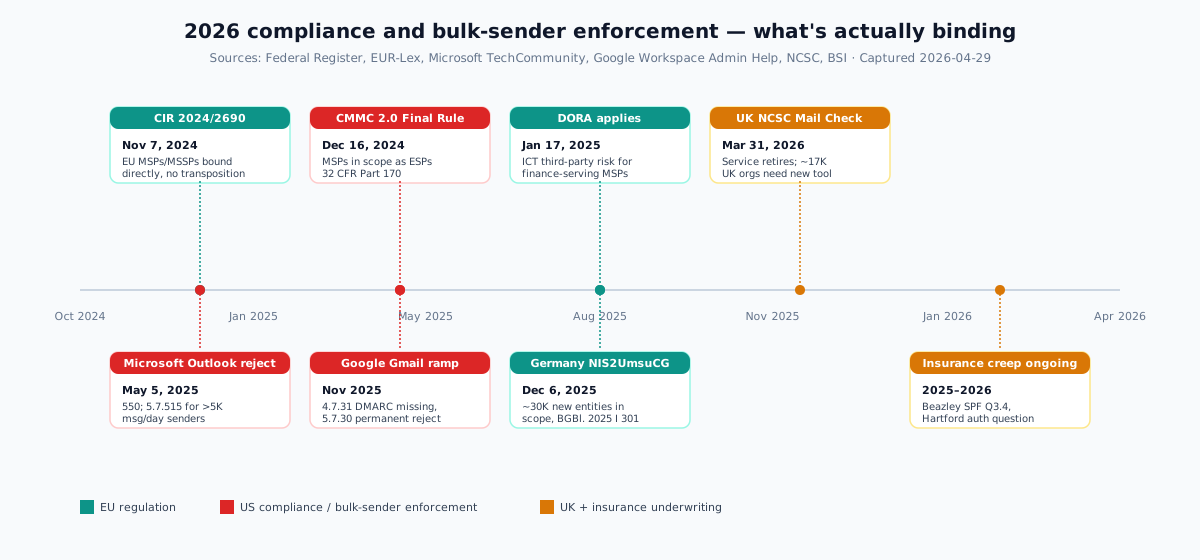
DMARC stopped being a “nice to have” in the MSP channel sometime between April 2024 and November 2025. The forcing functions are bulk-sender mandates, EU regulation, US compliance frameworks, and cyber insurance underwriting — all converging on the same six-month window.
Bulk-sender mandates. Microsoft Outlook, Hotmail, and Live.com began
routing non-compliant high-volume mail to Junk on May 5, 2025 — the documented
rejection is 550; 5.7.515 Access denied, sending domain [SendingDomain] does not meet the required authentication level, with a blanket rejection date
still unannounced — for any domain sending more than 5,000 messages per day to
consumer mailboxes that fails SPF, fails DKIM, or lacks a DMARC record at
minimum p=none with alignment, per the
Microsoft Defender for Office 365 blog (April 2025).
Google’s Gmail enforcement ramp started November 2025; the
Email Sender Guidelines FAQ
documents temporary codes 4.7.23, 4.7.27, 4.7.29, 4.7.30, 4.7.31 (DMARC
missing — the Gmail SMTP errors reference lists the same deferral as 4.7.40),
and 4.7.32, plus permanent 5.7.25, 5.7.27, 5.7.29 and 5.7.30. Bulk-sender
status is permanent once assigned. Yahoo’s evaluation runs continuously.
Compliance pressure. The CMMC 2.0 final rule (32 CFR Part 170) took effect December 16, 2024 and pulls MSPs in as External Service Providers. DFARS 252.204-7021 phases into contracts from November 10, 2025. EU Commission Implementing Regulation (EU) 2024/2690 binds MSPs and MSSPs directly without national transposition; Germany’s NIS2UmsuCG went live December 6, 2025. DORA applies from January 17, 2025 for MSPs serving banks, insurers, investment firms, and crypto-asset providers.
Cyber insurance creep. Beazley’s cyber application asks SPF enforcement directly in Section 3, Q3.4. The Hartford’s CyberChoice Ransomware supplement asks “which protocols are used to authenticate the sender and content of emails.” Coalition’s 2026 Cyber Claims Report puts BEC plus funds-transfer fraud at 58% of all claims, with 71% of FTF claims involving social engineering. At-Bay’s 2025 InsurSec Rankings Report found 43% of all 2024 incidents began with malicious email and 83% of fraud attacks did. The FBI IC3 2025 Internet Crime Report logged $3.05 billion in BEC losses across 24,768 complaints — second only to investment fraud.
Demand-side data. Per our internal ICP research, only ~10–20% of MSPs offer DMARC-as-a-service today, while 54% of IT leaders say they would outsource DMARC to a specialist. The window is open and the channel press has noticed: ChannelE2E, ChannelPro, IT Nation Wise Up, and IT Business Podcast all ran “DMARC for MSPs” feature coverage between July 2025 and December 2025.
If you’re not selling DMARC to your clients, your competitor is — and the underwriter is asking your client about SPF on the renewal form.
The Real MSP Pricing Picture (Wholesale + Retail)
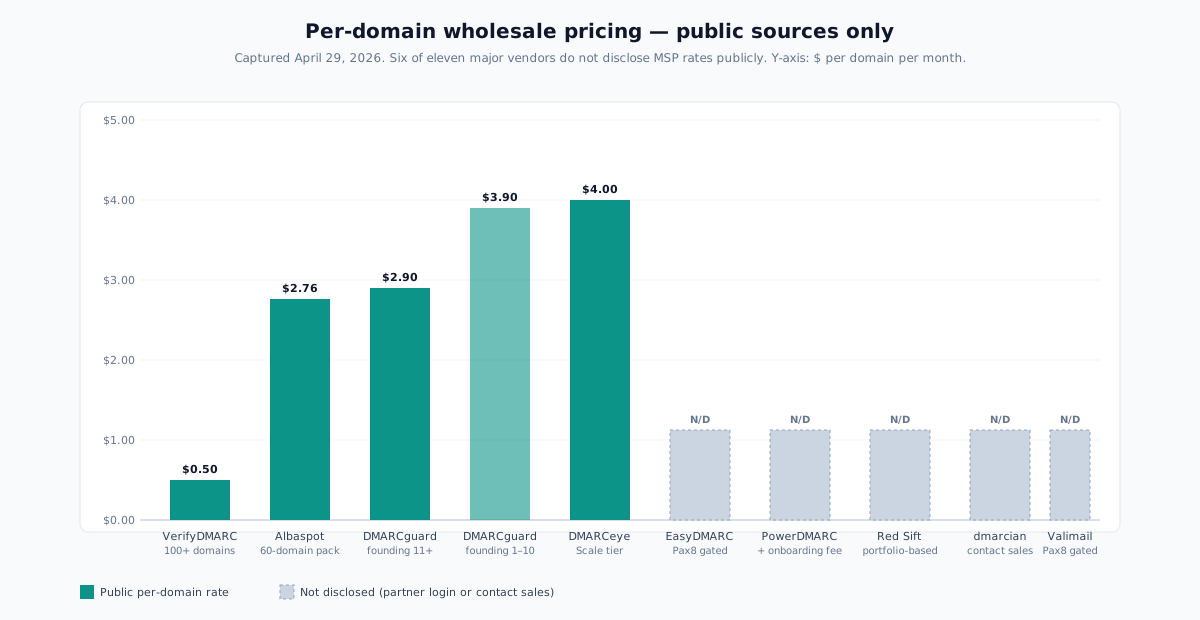
Here is the honest top-line, verified the day this post was published: every major DMARC vendor’s MSP wholesale rate is gated behind Pax8, ConnectWise, or Sherweb partner login, or “contact sales.” An MSP cannot do an apples-to-apples $/domain comparison without authenticating into three or more partner portals or sitting through three sales calls. (Valimail is a partial exception: its wholesale rate is gated, but retail Enforce Starter is publicly listed at “starting at $5,000/year.”) The “free dmarc monitoring” partner pages on the SERP imply transparency they do not deliver.
What is publicly verifiable, accessed August 29, 2026:
| Vendor | Public MSP rate | Source |
|---|---|---|
| EasyDMARC MSP | Not disclosed (Pax8 gated) | easydmarc.com/pricing/easydmarc/msp |
| PowerDMARC MSSP | Not disclosed (PAYG) | powerdmarc.com/dmarc-msp-mssp-partner-program |
| Sendmarc | Not disclosed (PAYG) | sendmarc.com/partners |
| Red Sift OnDMARC | No public rate (contact msp@redsift.io) | redsift.com/partners/msp-program |
| dmarcian | Custom (contact) | dmarcian.com/become-a-partner |
| Valimail | Not disclosed (Pax8 gated) | valimail.com/partners |
| VerifyDMARC | $1.00 → $0.50/domain/mo | verifydmarc.com/msp |
| DMARCguard founding | $14.50/mo incl. 2 domains, $7.50 at 3–10, $5 at 11+ | dmarcguard.io/pricing |
| DMARCeye Scale | $4.00/domain/mo (caps at 50 domains) | dmarceye.com/pricing |
| Albaspot | $4.00/domain/mo (flat, no tiers) | albaspot.com/pricing |
| DMARCReport partner | 50% off list, +volume tiers | dmarcreport.com/pricing |
DMARCguard pricing is quoted net: excl. VAT & sales tax. Competitor prices are shown as each vendor publishes them.
That’s the full set of publicly disclosed MSP-targeted rates as of late August 2026. The discovery itself is the differentiator: no verifiable peer-quoted MSP $/domain retail figures exist in indexed public sources. The peer pricing conversation lives in gated communities (MSPGeek Discord, r/msp behind de-indexing). Vendor wholesale rate cards live behind partner-portal logins. Operators looking for honest budget comparison have to do the legwork themselves or trust a single vendor’s framing.
Markup math. UseDMARCReport publishes a partner page where the channel cost is $1,950 per domain and the realized retail is $3,000 to $5,000 per domain — a 35% to 61% gross margin and a 2× markup on a one-time setup project. dmarcian’s Enterprise tier retail equivalent works out to roughly $33.27 per active domain per month on the annual basis ($5,988/yr for 15 domains); the sticker monthly price is $600/mo. At the cheap end of the wholesale spread (DmarcDkim at €0.33/domain, VerifyDMARC at $0.50/domain at 100+ domains), the realized MSP margin is decided by tool selection, not retail-pricing skill. The wholesale spread is roughly 15×; the retail spread is roughly 2×.
Retail pricing reality. Red Sift’s MSP pricing guide notes that MSP per-user security packages run $110–$175/user/month for standard tiers and $175–$400/user/month for advanced security tiers, with DMARC bundled into the stack rather than line-itemed. DmarcDkim suggests MSPs charge “up to 10 hours per month per client” depending on size and service level — an hourly-retainer model on top of a near-zero wholesale.
Pricing-objection callouts. The Trustpilot record on EasyDMARC is unambiguous on free-tier rug-pulls. Three verbatim reviews captured during research: “They got rid of the free plan, which I think was a big mistake, but worse is they simply crippled any account that was using it, blocking all access to your domains, even if you also had domains on a paid plan, you were denied access to them.” A second: “They got rid of the free plan… removed/disabled all the other domains that were on the free plan. They also doubled all the prices on the paid plans, so their pricing is no longer very competitive.” A third: “EasyDMARC recently changed their plans, and capped the maximum number of domains from unlimited to 1 on free accounts. No warning, no emails about this, nothing.” A G2 reviewer also flagged the BIMI certificate paywall, and a Capterra MSP user requested a billing API that did not exist at the time of writing. None of these reviewers carry verifiable dates because Trustpilot returned 403 to programmatic fetch during research; the verbatim text is reproduced as captured.
DMARCguard’s posture is the inverse. Pricing is public on /pricing. Founding rate ($14.50/mo including 2 domains, then $7.50/domain (3–10) and $5/domain (11+)) is locked for 24 months, after which founding members keep a permanent 15% alumni discount off standard pricing on every plan and tier — see our pricing page for the terms in plain text. We don’t gut the free tier. We don’t paywall BIMI verification. We ship a billing- ready REST API today.
If you’re comparing against a specific incumbent, our EasyDMARC alternative deep-dive and compare page for DMARCguard vs EasyDMARC walk through the rest of the feature delta.
Multi-Tenant Operations: Where the Margin Actually Lives
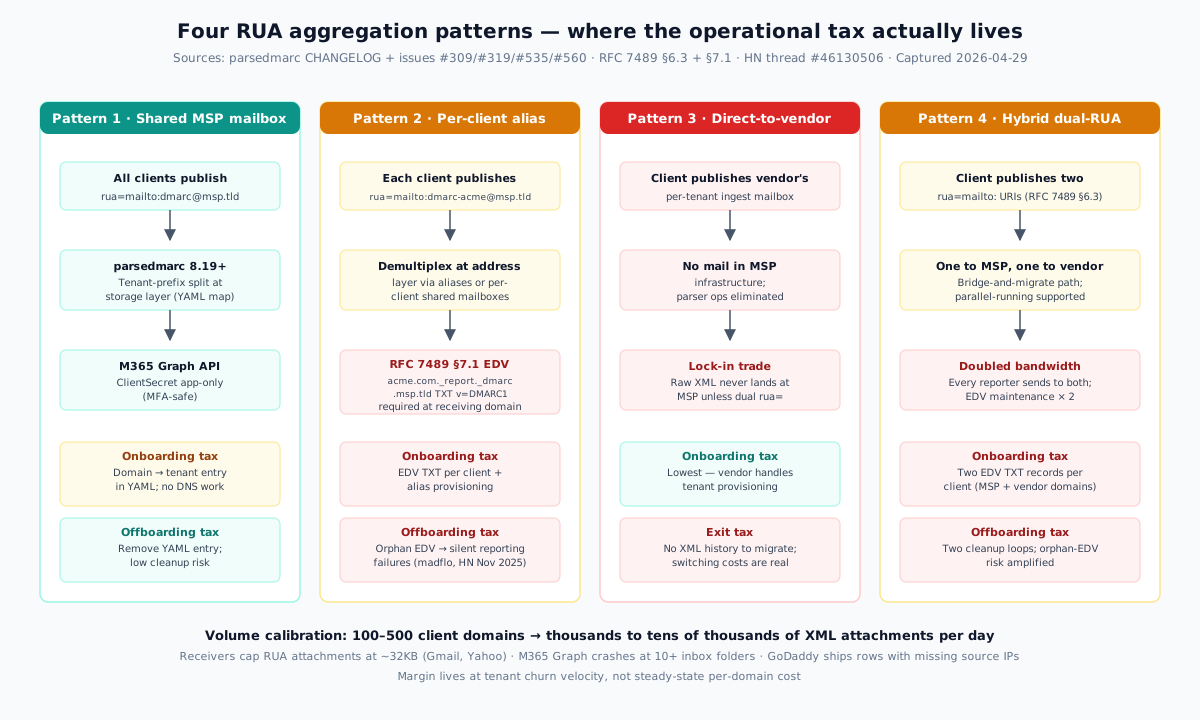
Here’s a counter-intuitive thesis that fell out of the practitioner record: the operational tax is concentrated in onboarding and offboarding, not steady-state. Your DMARC margin is decided at tenant churn velocity, not per-domain steady-state cost.
That is not vendor framing. It is the recurring shape of every parsedmarc issue, every Hacker News comment, and every multi-tenant DMARC monitoring review we found. Once a tenant is provisioned and quiet, the per-domain cost to keep watching is small. The cost is the provisioning event itself, the external domain verification, and the orphaned RUA cleanup six months later when the client churns.
RUA aggregation patterns
Four patterns dominate, each with different ops profiles:
- Single shared MSP mailbox + downstream tenant-prefix split. All
clients publish
rua=mailto:dmarc@msp.tld; the parser splits per-tenant at the storage layer via a YAML domain→tenant index-prefix mapping. parsedmarc 8.19+ supports this directly. M365 production path is Graph API withClientSecretapp-only auth —UsernamePasswordbreaks under MFA and conditional access, which is why parsedmarc issues #319, #330, and #560 recur in 2024 and 2025. - Per-client RUA address on MSP domain (
dmarc-acme@msp.tld) via aliases or per-client shared mailboxes. Demultiplexes at the address layer. Hidden cost: every client onboarding requires a TXT record at<clientdomain>._report._dmarc.msp.tldper RFC 7489 §7.1 External Domain Verification. Missed EDV is the single most common silent reporting failure in MSP environments — andmadfloon HN thread #46130506 (Nov 2025) confirmed it from the receiving side: “I do operate DMARC report processing service and I have to agree that outdated reporting addresses living in DNS records (in my case, previous customers of mine still using their reporting addresses) are an issue.” - Direct-to-vendor ingest (RUA points at the vendor’s per-tenant
ingest mailbox; mail never lands in MSP infrastructure). Pattern
eliminates parser ops but creates lock-in: raw XML never lands at the
MSP unless dual
rua=is configured. - Hybrid dual-RUA fan-out. Client publishes two
rua=mailto:URIs (RFC 7489 §6.3 allows up to two), one to MSP, one to vendor. Doubles outbound bandwidth from every reporter and doubles the EDV maintenance surface (TXT records on two receiving domains per client). Used as a bridge-and-migrate path.
Volume calibration
Google’s Workspace admin docs note that “every mail server you send email
to will send you a daily report… large organizations might get up to
hundreds or even thousands of reports daily.” Extrapolated to MSP scale at
100–500 client domains, that’s thousands to tens of thousands of XML
attachments per day. DMARCReport’s $25/mo “Guard” tier is calibrated for
100,000 reports/month across 5 domains — roughly 650 per domain per peak
day. Self-hosted parsedmarc author-recommended host spec is at minimum 3 GB
RAM and 4 CPU cores; the
parsedmarc CHANGELOG
shows MSP-scale stress fixes including Replace multiprocessing.Pool with Pipe + Process, Increase http.client._MAXHEADERS from 100 to 200, and
Skip invalid aggregate report rows… GoDaddy will send reports with some rows missing a source IP address.
Edge cases that bite
The parsedmarc bug tracker and the November 2025 HN thread enumerate the
practical failure modes. Receivers Gmail and Yahoo cap RUA attachments at
roughly 32 KB and silently truncate larger reports with no error
indication. M365 only emits RUA when the client tenant’s MX points
directly at Exchange Online — hybrid mail routing on the client side
silently kills outbound RUA emission. Microsoft Graph crashes when an
inbox contains 10 or more folders (parsedmarc CHANGELOG fix). Google
duplicates DMARC reports for some Gmail tenants 5 to 10 times — b112
on HN: “I routinely get between 5 and 10 duplicates of DMARC reports
from Google for gmail. Searching on this, it’s a known phenomenon. No one
else has this issue.” And Microsoft RUA reports don’t reflect Hotmail-side
silent drops — nemetroid: “Microsoft sends me DMARC reports saying
‘yes, everything was accepted 100%, all good’. The delivery logs on our
end look good as well. However, they silently drop a large portion of
messages with a Hotmail destination.”
Per-client reporting cadence
The pattern that recurs across CIAOPS, Palisade, Business of Tech, and the Wise Up podcast: internal NOC daily or weekly review → monthly one-page client scorecard → quarterly QBR slide. Real-time client portal access is universally available but rarely the primary deliverable. The CIAOPS Pass/Partial/Fail scorecard pattern treats DMARC as one binary control among many in a baseline scorecard — not its own report. White-label is heavily marketed but rarely independently attested in the practitioner record.
Alert hierarchy — queue, don’t page
The webhook-based severity split is the community-tooling primitive:
parsedmarc INI exposes aggregate_url, forensic_url, and smtp_tls_url
as distinct webhook targets. The HaloPSA pattern is a per-Domain-Group
toggle of which DMARC alert types create tickets — not blanket auto-ticket.
Documented operational cadence is “queue, don’t page”: HaloPSA syncs
sending-domain inventory once every 24 hours overnight, and only
configured events fire real-time tickets. toast0 on the November 2025
HN thread put it bluntly: “Back when I ran email for a large sender, I
turned DMARC reports off once I got things settled in, and might turn it
on to debug issues. There was nothing to do about the reports most of the
time.”
What DMARCguard ships today (proof, not pitch)
Named sender identification — see “Mailchimp” or “SendGrid,” not
“52.24.128.5” — across 170+ services. Multi-tenant org support with RBAC
(owner / admin / viewer). Org-aware JWTs and per-org JSON settings live
under internal/orgsettings/. The MCP server exposes 17 AI tools for
tenant-aware conversational queries — useful when a technician needs to
ask “which senders failed DKIM alignment for client Acme this week?”
without logging into a dashboard. None of this is roadmap; the file paths
ship in the binary today.
Channel Integrations Matrix — What Actually Ships
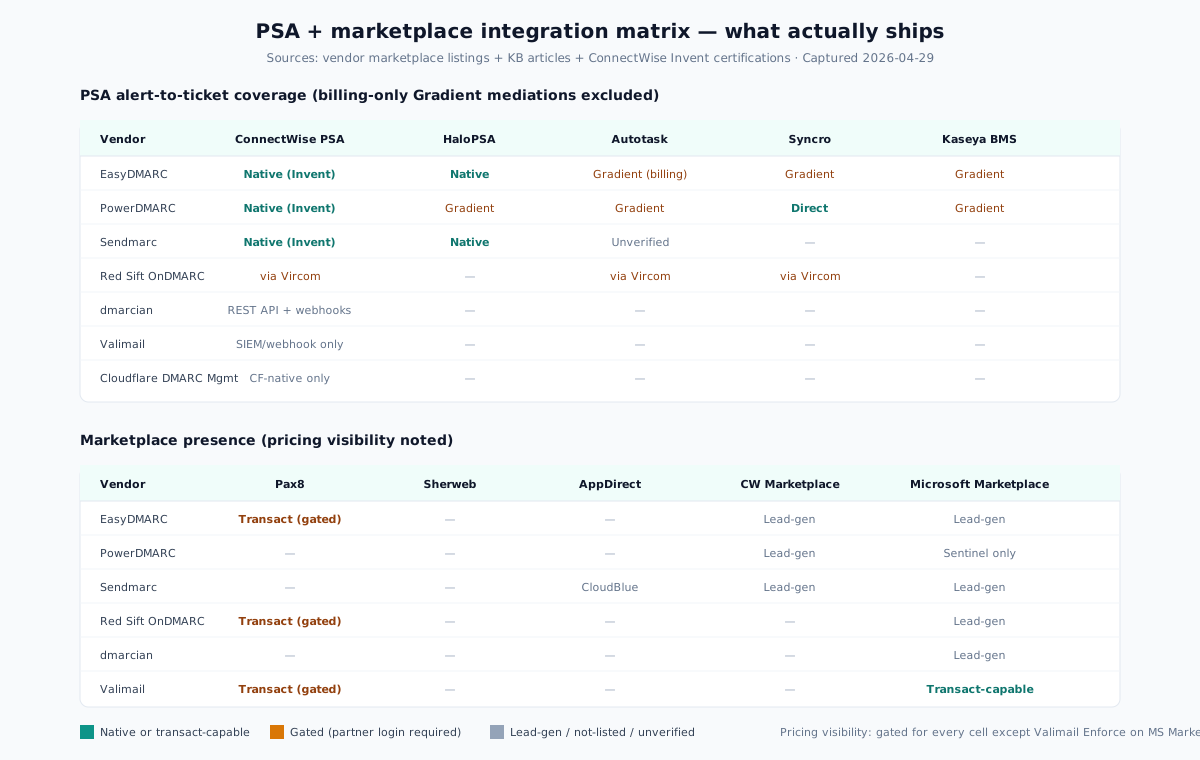
Frame: vendor partner pages claim “PSA integration.” Half the time that means billing reconciliation via Gradient MSP, not alert-to-ticket. The two are not the same. Treat the claim with skepticism and ask the vendor to demo a ticket creation, not a domain-count sync.
PSA / ticketing matrix (alert-to-ticket only, billing-only excluded)
| Vendor | ConnectWise PSA | HaloPSA | Autotask | Syncro | Kaseya BMS |
|---|---|---|---|---|---|
| EasyDMARC | Native (Invent) | Native | Gradient (billing) | Gradient | Gradient |
| PowerDMARC | Native (Invent) | Gradient | Gradient | Direct (vendor page) | Gradient |
| Sendmarc | Native (Invent) | Native | Help-center menu only (unverified) | — | — |
| Red Sift | via Vircom only | — | via Vircom | via Vircom | — |
| dmarcian | REST API + webhooks only | — | — | — | — |
| Valimail | SIEM/webhook export only | — | — | — | — |
| Cloudflare DMARC Mgmt | — (CF-native) | — | — | — | — |
The PSA story collapses fast outside ConnectWise. EasyDMARC and Sendmarc are the only vendors with native HaloPSA alert-to-ticket integrations verified in primary sources. dmarcian and Valimail are REST API and webhook only — usable, but every MSP builds the integration themselves.
Marketplace presence
| Vendor | Pax8 | Sherweb | AppDirect | CW Marketplace | Microsoft Marketplace |
|---|---|---|---|---|---|
| EasyDMARC | Transact (gated) | — | — | Lead-gen | Lead-gen |
| PowerDMARC | — | — | — | Lead-gen | Sentinel only |
| Sendmarc | — | — | CloudBlue only | Lead-gen | Lead-gen |
| Red Sift | Transact (gated) | — | — | — | Lead-gen |
| dmarcian | — | — | — | — | Lead-gen |
| Valimail | Transact (gated) | — | — | — | Transact-capable |
Pricing visibility is gated for every combination above except Valimail Enforce on Microsoft Marketplace. Pax8 is not a transparent MSP rate card; it is a sales channel with a login wall. Treat marketplace presence as procurement convenience, not as evidence of pricing transparency.
Documentation tie-in
Hudu v2.37.0 (May 2025) added native DMARC, DKIM, and SPF DNS monitoring
with one documented limitation — Hudu does not perform DNS lookups on
subdomains when monitoring SPF and DMARC records, per
Hudu’s release notes.
The community workaround pre-native was the
JohnDuprey/DNSHealth
PowerShell module paired with HuduAPI-PowerShell. IT Glue ships no
DMARC-vendor integration; manual Flexible Asset templates only. Confluence
ships zero DMARC monitoring apps from any of the seven vendors.
Compliance pipes
None of the seven major DMARC vendors ship native integrations to Vanta, Drata, or Secureframe (300+ integrations each, A–Z catalog reviewed April 29, 2026). Custom Connections / Tests JSON or manual evidence upload is required. The named hook is CIS Critical Security Controls v8.1 Safeguard 9.5: “Implement DMARC,” mapped to NIST CSF 2.0.
DMARCguard roadmap honesty
Per our marketplace strategy doc, Pax8 and ConnectWise listings are Phase 5 — Month 12+, gated on Phase 7 white-label. We won’t pretend otherwise. What ships today: REST API, webhooks, MCP server with 17 AI tools, Slack / Teams / Discord / PagerDuty alerts, PDF audit reports, multi-tenant with RBAC. If your procurement workflow strictly requires a Pax8 SKU on day one, we are honest about not being your vendor yet. If you can wire a webhook into your PSA today, we are your vendor today. For more on continuous monitoring vs point-in-time DNS lookups, see our MXToolbox alternative deep-dive and ARC primer.
2026 Compliance Pressure — What’s Actually Binding
The honest framing: DMARC is not literally named in CMMC 2.0, NIS2, DORA, or CIR 2024/2690. It is the implementer’s choice as state-of-the-art email authentication under “basic cyber hygiene” and “supply chain security” language. Vendor marketing that implies otherwise is overreach. Channel-press coverage from ChannelE2E, ChannelPro, and IT Nation Wise Up has converged on framing DMARC as MSP table-stakes, but the binding text is more nuanced.
CISA / US Federal
The CISA Secure-by-Design Pledge has MSP signatories (ConnectWise, N-able, Huntress, Pax8, Compliance Scorecard) but no explicit DMARC commitment in the seven goals. CMMC 2.0 final rule effective December 16, 2024 (32 CFR Part 170) pulls MSPs in as External Service Providers — DMARC is not literally named, but NIST SP 800-171 R2 §3.13.x boundary protection and §3.14.x system integrity are the implicit hooks. DFARS 252.204-7021 phased rollout from November 10, 2025 ties contract eligibility to certification posture. The standing federal-agency DMARC mandate (BOD 18-01) binds .gov agencies, not MSPs.
EU NIS2 + DORA
CIR 2024/2690 in force November 7, 2024 directly binds MSPs and MSSPs without national transposition. Annex sections that map to DMARC implicitly: §5 (supply chain security), §6.7 (network security), §6.9 (malicious software), §8 (cyber hygiene). National transposition snapshot as of late August 2026: Germany NIS2UmsuCG live December 6, 2025; Netherlands and Ireland not yet enacted; the European Commission issued reasoned opinions to 19 Member States on May 7, 2025 for non-transposition. DORA applies from January 17, 2025; Articles 28–30 govern ICT third-party risk for MSPs serving banks, insurers, and crypto-asset providers.
UK NCSC
The UK NCSC Mail Check service retires March 31, 2026. Aggregate (RUA) reporting and DKIM checks were removed March 24, 2025. UK organisations registered to Mail Check are being directed to procure commercial DMARC tooling — a direct MSP demand signal. Our NCSC Mail Check migration checker shows what a departing tenant needs to replace.
Cyber insurance
Beazley’s cyber application asks SPF enforcement directly in Section 3, Q3.4. The Hartford’s CyberChoice Ransomware supplement asks “which protocols are used to authenticate the sender and content of emails.” Coalition Control external scans flag SPF misconfigurations as silent renewal contingencies. Coalition’s 2026 Cyber Claims Report puts BEC + FTF at 58% of all claims; 71% of FTF claims involved social engineering. No carrier publishes a premium-discount schedule tied to DMARC at p=reject yet — that’s the next shoe to drop, and worth watching.
Channel voice
Two practitioners worth quoting verbatim. Eddie Phillips, Global Director of Partner Success at IRONSCALES, in ChannelE2E (July 8, 2025): “DMARC has moved from a technical nice-to-have to a business-critical requirement. For MSPs, it’s now a defining factor in security, deliverability, and client trust.” Joe Garner, MSP Program Manager at dmarcian, in ChannelPro Network (December 22, 2025): “DMARC compliance is becoming increasingly important. Major email providers like Google, Yahoo and Microsoft now require organizations to have a DMARC record in place. Additionally, many cybersecurity insurance providers are making DMARC a requirement for coverage.” Both bylines carry vendor affiliation; the convergence of language across competing vendors is itself the signal.
For a deeper compliance dive, see our PCI DSS DMARC requirement primer.
Buyer-Journey Objections — What MSPs Actually Ask
Each objection is reproduced as it shows up in third-party reviews or practitioner forums. The DMARCguard answer cites the actual file path or feature in the codebase to demonstrate it ships, not aspirational. We don’t disparage other vendors — just describe what is and isn’t in our shipped product.
Objection 1: “We’ve been burned by free-tier rug-pulls and overnight price doubles.” The Trustpilot record on EasyDMARC reproduces the verbatim pain. DMARCguard’s posture: pricing is public on /pricing; the founding rate is locked for 24 months and founding members keep a permanent 15% alumni discount on every plan and tier afterward; we never gut the free tier (red-line commitment #1 in our brand voice). Free is 7 protocols, 2 domains, 30-day retention forever.
Objection 2: “Tenant-switching in MSSP consoles is cumbersome — log
out of sub-tenant, back to main console, log in again.” Verbatim G2
PowerDMARC review: “The multi-tenant feature can be a bit cumbersome in
that to switch tenants you need to log out of a sub-tenant, go back to
the main console then login again.” DMARCguard’s OrgMiddleware
switches via the X-Org-Id header in one click; org-aware JWTs carry the
tenant scope; per-org JSON settings live in internal/orgsettings/.
No logout/login cycle.
Objection 3: “We need an API for our billing process.” Verbatim Capterra EasyDMARC review (Paul D., CEO, IT Services). DMARCguard ships REST API, MCP server, and webhooks today. Domain-add events fire webhooks for downstream Gradient or custom billing pipelines. We are the API your billing system already speaks.
Objection 4: “Multi-tenant feels bolted on. We need real data
isolation.” DMARCguard ships org-scoped storage, encrypted OIDC
tokens (internal/crypto/ AES-256-GCM, key from ENCRYPTION_KEY
env), and OrgMiddleware enforced on /api/*. Single binary,
embedded SQLite, no shared cluster. The OrgMiddleware was built
in response to the security audit we ran on ourselves — see commit C1
cross-tenant remediation.
Objection 5: “What’s the time-to-enforcement and risk of breaking
legitimate mail flow during onboarding?” Progressive enforcement:
p=none → p=quarantine → p=reject, staging each step with t=y
(test mode) so receivers apply the policy one level weaker while you
confirm legitimate mail. The legacy pct tag is deprecated in RFC 9989
but still honored by major receivers if you need a percentage rollout.
Named-sender remediation guidance per failing source. We tell you what
to change at which provider, not just what failed.
Objection 6: “Calculate my costs at 50, 100, 500 domains — no surprises.” Founding rate: $14.50/mo including 2 domains, then $7.50/domain (3–10) and $5/domain (11+), locked 24 months. 100 domains = $524.50/mo. 500 domains = $2,524.50/mo. Public math, no contact-sales gate.
On standard pricing post-founding, the alumni 15% discount keeps the rate competitive against the Pax8 gated SKUs you can't actually compare to.Objection 7: “Vendor lock-in. What’s our exit plan?” Full CSV and JSON export, REST API, raw aggregate XML accessible. DMARC is a standard (RFC 9989), not a proprietary format. We earn loyalty through quality, not data hostage. If you want out, you can leave.
Objection 8: “You don’t ship a Pax8 / ConnectWise listing yet.” Correct. Per the integrations matrix above, Pax8 is Phase 5 — Month 12+. What ships today is REST API, MCP, webhooks, multi-tenant, and RBAC. Honest now beats performative later. If your procurement workflow strictly requires a Pax8 SKU on day one, we are honest about not being your vendor yet.
If you’re cross-shopping DMARCguard against the established players, our compare pages line up the features one-for-one: vs EasyDMARC, vs dmarcian, vs PowerDMARC, and vs Valimail.
Productizing DMARC as a Managed Service — Real Numbers
Three pricing motions show up in the practitioner record. Pick one or mix two.
1. Per-domain markup. Wholesale from $5/domain at volume → retail $12–$20/domain/mo. Easy mental math for clients (“$12 per domain, you have 8 domains, $96 a month” — 38% margin at that size, widening as the estate grows past 11 domains). This is the cleanest model for MSPs whose clients ask for itemized invoices.
2. Bundled into security tier. Per-user $110–$400/mo per Red Sift’s industry guide for MSPs. DMARC isn’t line-itemed; it’s a feature of “managed security.” Higher LTV, harder to attribute revenue, but the ARPU expansion is real because the client never sees DMARC as a separable charge to push back on.
3. Setup fee + recurring. UseDMARCReport’s published partner page documents $3,000–$5,000 one-time per domain for monitor → enforce migration; recurring monitoring billed separately. Front-loads margin, requires sales motion. The 1-MSP / PowerDMARC case study at MSPGeekCon 2025 documents the white-label resell motion working at scale, though specific $/domain figures were not disclosed publicly.
24-month tenant economics example
Math only, no estimates outside the verifiable wholesale data above. At 50 client domains on DMARCguard founding wholesale ($14.50/mo including 2 domains, then $7.50/domain (3–10) and $5/domain (11+)): $14.50 + 8 × $7.50 + 40 × $5 = $274.50/mo cost. At retail $12/domain × 50 = $600/mo revenue. Gross margin: 54%. At 200 domains: $14.50 + 8 × $7.50 + 190 × $5 = $1,024.50/mo cost; $2,400/mo revenue at $12/domain; 57% gross margin. At 500 domains: $14.50 + 8 × $7.50 + 490 × $5 = $2,524.50/mo cost; $6,000/mo revenue; 58% gross margin.
Tenant churn velocity is the hidden variable
EDV records on the MSP domain per client, Graph auth provisioning per tenant, orphaned RUA cleanup post-churn — these compound. Steady-state margin looks great; onboarding tax can erase it at >5%/quarter churn. Price your service for the onboarding tax, not just the monthly seat.
What to charge
The only verifiable practitioner number for retail recurring is the UseDMARCReport $3,000–$5,000 setup band. Recurring numbers are not in indexed public sources — peer disclosure happens in gated communities (MSPGeek Discord, r/msp). The honest answer: market test at three retail price points, watch close rate at each, normalize.
For the founding rate and the 24-month price-lock and alumni discount mechanics, see /pricing — multi-tenant, RBAC, REST API, and webhooks are all included in Pro.
FAQ
How is DMARC for MSPs different from DMARC for a single company?
Multi-tenant data isolation, white-label reporting, per-client RUA aggregation, and PSA alert-to-ticket mapping. The protocol is identical (RFC 9989); the operations are not. An MSP at 100 client domains processes thousands of XML reports per day across separate tenants, while a single company processes hundreds for one tenant. Tooling that doesn’t model “tenant” as a first-class concept will break at scale.
What’s the actual wholesale price MSPs pay for DMARC tools in 2026?
Most major vendors hide it behind Pax8, ConnectWise, or Sherweb partner login, or “contact sales.” Verifiable public per-domain rates accessed August 29, 2026: VerifyDMARC $0.50–$1.00 (volume), DMARCguard founding from $5 at volume, DMARCeye and Albaspot $4.00, DMARCReport partner 50% off list. EasyDMARC, PowerDMARC, Sendmarc, Red Sift, dmarcian, and Valimail wholesale rates require partner authentication.
Does my MSP need to publish a DMARC record at the receiving domain?
Yes. RFC 7489 §7.1
External Domain Verification: if your client publishes
rua=mailto:dmarc-acme@msp.tld and acme.com differs from msp.tld,
you must add a TXT record at acme.com._report._dmarc.msp.tld
containing v=DMARC1. Missed EDV is the single most common silent
reporting failure in MSP environments.
Do cyber insurance carriers require DMARC?
Some explicitly, some implicitly. Beazley’s cyber application asks SPF enforcement directly (Section 3, Q3.4). The Hartford’s CyberChoice Ransomware supplement asks “which protocols are used to authenticate the sender and content of emails.” Coalition Control external scans flag SPF misconfigurations as silent renewal contingencies. No carrier publishes a premium-discount schedule tied to DMARC at p=reject yet.
Can I run DMARCguard for multiple clients in one instance?
Yes. Multi-tenant is built in. OrgMiddleware enforces tenant scoping
via the X-Org-Id header; org-aware JWTs; per-org JSON settings; RBAC
(owner / admin / viewer); encrypted OIDC tokens with AES-256-GCM. See
/pricing for per-domain MSP rates
and the founding price-lock terms.
What’s the catch with vendor partner pages saying “free for MSPs”?
Free tiers historically get reduced or eliminated. Trustpilot reviewers of a major DMARC vendor cite verbatim that “they got rid of the free plan” with “no warning, no emails.” Read the change log and ToS, not the marketing page. DMARCguard Free is 7 protocols, 2 domains, 30-day retention forever — locked by our brand voice red-line commitments.
Conclusion
Three honest takeaways from the DMARC for MSPs landscape in 2026:
- Vendor partner pages dominate the SERP; the independent practitioner record is conspicuously quieter on labor-to-revenue mismatch (the HN josefresco quote that opened this post), free-tier rug-pulls (Trustpilot on EasyDMARC), and bolted-on multi-tenancy (G2 on PowerDMARC). Build your stack on that data, not on vendor promo pages.
- Margin lives in tenant churn velocity, not steady-state per-domain cost. Onboarding EDV records, Graph auth provisioning, and offboarding orphan cleanup compound. Price your service for the onboarding tax, not the monthly seat.
- 2026 compliance pressure is real but not literal. DMARC is not named in CMMC 2.0, NIS2, DORA, or CIR 2024/2690 — it’s the implementer’s choice as state-of-the-art under “basic cyber hygiene” language. The harder forcing functions are bulk-sender enforcement (Google, Microsoft, Yahoo) and cyber insurance application forms.
If you’ve read this far, you’re the operator vendor partner pages weren’t written for. The DMARCguard counter-offer is a single-binary multi-tenant DMARC platform with public per-domain pricing, REST API and MCP today, and a 24-month founding price-lock plus permanent 15% alumni discount thereafter. Pax8 listing on Phase 5 roadmap; we’ll be honest about that until it ships. Until then, the webhook is ready when your PSA is.
For continued reading, the best DMARC monitoring tools for MSPs in 2026 companion piece ranks the field with the same vendor-skeptical lens. Side-by-side compare pages: EasyDMARC, dmarcian, PowerDMARC, Valimail.