dmarcian Alternative: Why Teams Are Switching for Full Protocol Coverage in 2026
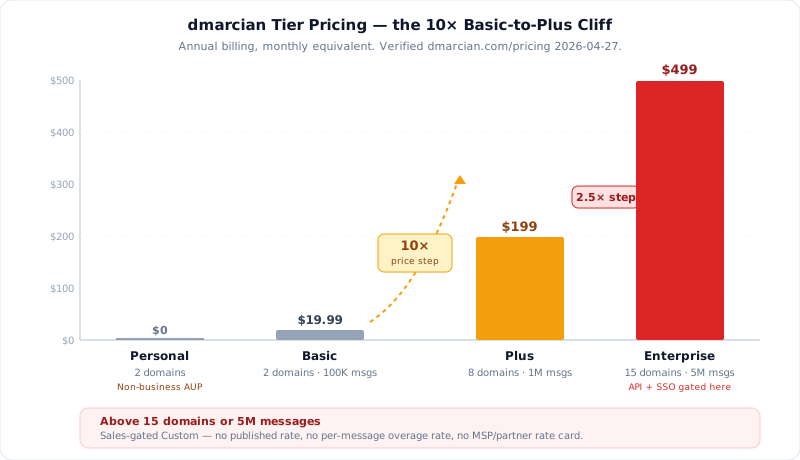
You opened your dmarcian portal, watched a third domain push you over the Basic plan’s two-domain ceiling, and clicked through. The number on the next tier was not what you expected. Basic at $19.99 per month (billed annually) jumps directly to Plus at $199 per month — a 10× increase for the same domain-count change from two to eight, with no mid-tier between them. Enterprise is another 2.5× step to $499 per month for fifteen domains, and that is where API access and SAML SSO start. Pricing is published at dmarcian.com/pricing, 2026-04-27.
If you are searching for a dmarcian alternative, you are here because of one of three pressures. Pricing is the loudest. Compliance is second — Gmail and Yahoo’s February 2024 bulk-sender requirements (Google’s threshold is 5,000 messages per day; Yahoo publishes no volume number), Microsoft Outlook’s May 5, 2025 enforcement, the NCSC Mail Check retirement on March 31, 2026, and PCI DSS v4.0 Section 5.4.1 all push email teams to re-evaluate the tool that is supposed to keep them compliant. Third is feature gravity: dmarcian is a 12-year-old reporting platform that has stopped at DMARC, SPF, and DKIM with TLS-RPT bolted on in 2024. ARC, BIMI, MTA-STS hosting, and DANE are not productized at any tier.
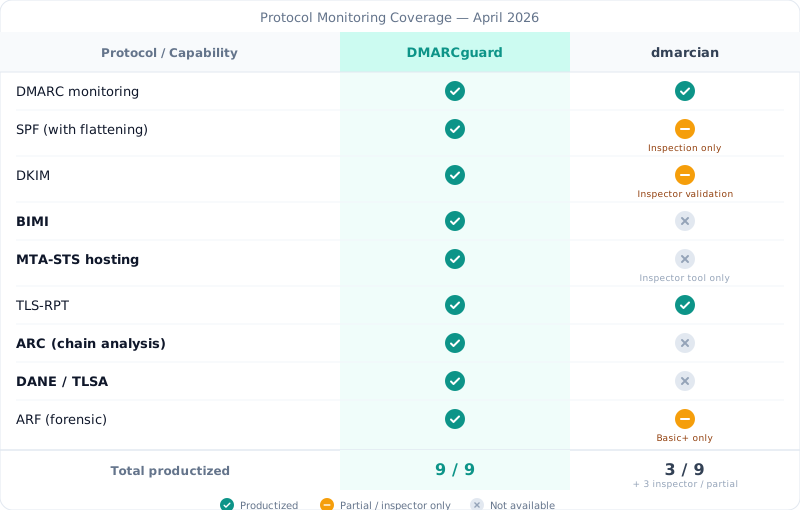
This guide compares the best dmarcian alternatives on protocol coverage (9 vs 3), pricing math at five, twenty-five, and one hundred domains, three verified switcher quotes, and a six-week, RFC-7489-§6.2-compliant migration playbook with the §7.1 External Destination Verification check no competitor switcher page publishes. See the side-by-side feature and pricing comparison for the full table.
Why Teams Are Searching for a dmarcian Alternative in 2026
The switcher narrative is three pressures that arrive on different timelines, hit different buyers, and end at different destinations. Sourced from Capterra, G2, dmarcian’s forum, and competitor review pages.
The Pricing Cliff: 10× Basic to Plus Jump
dmarcian’s published tiers are stable and have not moved in at least 24 months — itself a useful signal in a market that adjusted pricing repeatedly through 2024 and 2025. The published path at dmarcian.com/pricing is:
- Personal — free, 2 domains, 1,250 DMARC-capable messages per month, 1 month retention, non-business use only (dmarcian audits compliance and Personal accounts tied to a business expire).
- Basic — $19.99/mo billed annually ($24/mo monthly), 2 domains, 100,000 messages, 3 months retention.
- Plus — $199/mo billed annually ($240/mo monthly), 8 domains, 1,000,000 messages, 1 year retention.
- Enterprise — $499/mo billed annually ($600/mo monthly), 15 domains, 5,000,000 messages, unlimited retention.
- Custom — sales-gated, no published rate, for >15 domains or >5M messages.
Two clauses worth reading before you renew. First, the August 2024 Terms of Service (§4) include an auto-upgrade trigger after two consecutive months of overage — the customer is forced to the next tier and the higher rate is pro-rated for the rest of the term. Second, §4.1 of the Master Agreement makes prepaid fees non-refundable; §10.5 grants refunds only on customer-initiated termination for material breach with a 15-day cure window. Mid-term cancellation gets you no money back. Source: dmarcian.com/terms-of-service/.
The Basic-to-Plus step is the most-cited friction point on review platforms. Tytus J. on G2 (2024-02-22): “While they offer free tools, their paid services can be expensive for smaller organizations or individual users.” And on Capterra (2022-07-22), an anonymous reviewer described the inbound version — surprise billing on a tier assumed free: “I thought it was free, but then randomly saw that we were being billed double digits.” The quote is dated; the structure that produced it has not changed.
Compliance Pressure Is Pushing Buyers to Re-evaluate
Buyers rarely search “I need a NIS2-ready DMARC tool” — they search “dmarcian alternative” because their auditor or CISO told them the tool they have does not check enough boxes. The 2024–2026 enforcement timeline:
- February 2024: Gmail and Yahoo’s bulk-sender requirements went live — Gmail’s 5,000 msgs/day threshold (Yahoo names no volume), DMARC enforcement, list-unsubscribe, 0.3% spam-rate cap (Google announcement).
- March 31, 2025: PCI DSS v4.0 Section 5.4.1 became mandatory, naming DMARC, SPF, and DKIM as recommended controls.
- May 5, 2025: Microsoft Outlook enforced the same bulk-sender thresholds for Outlook.com, Hotmail, and Live.
- November 2025: Gmail moved from spam-folder placement to outright rejection for misaligned bulk mail.
- March 31, 2026: NCSC Mail Check, the UK government’s free DMARC monitoring service, was retired — UK public-sector and CNI-adjacent organizations are now forced into commercial monitoring.
dmarcian’s own NCSC Mail Check landing page exists because the trigger is real. UK buyers in particular are evaluating Red Sift OnDMARC for sovereignty reasons. The compliance pattern is the SEO white-space the top 10 SERP for “dmarcian alternative” almost universally fails to address.
Switcher Voices: Where Customers Actually Go
The most honest signal is the “Switched From” field on competitor review pages. Three verified Capterra quotes, all post-January 2024:
- “easy to implement and a good switch from DMARCIAN. pricepoint was better and the features were still the same.” — Josh E., CEO, DMARC Report review, 2024-07-24. Destination: DMARC Report (DuoCircle).
- “Better platform and easier to use. It makes our jobs easier. Formerly we used DMARCIAN.” — Jason M., Owner, DMARC Report review, 2024-07-29. Destination: DMARC Report (DuoCircle).
- “It had the much better reviews on G2Cloud, versus dmarcian.” — David P., CEO, EasyDMARC review, 2024-01-29. Destination: EasyDMARC.
The aggregate finding is asymmetric: switcher-out volume from dmarcian dramatically exceeds switcher-in. The publicly verifiable destination for SMB churn is DMARC Report (DuoCircle), with EasyDMARC and PowerDMARC trailing.
What dmarcian Covers — and Where It Stops
dmarcian is a reporting and visibility platform, not a managed-records platform. It receives DMARC XML and TLS-RPT JSON and shows what happened — but does not host your DMARC TXT record, rotate DKIM keys, host an MTA-STS policy, or seal ARC chains. Some teams want exactly that. Others find the gap painful when an auditor asks “show me the BIMI logo policy.”
dmarcian’s Protocol Coverage in 2026
Pulled from the live dmarcian pricing comparison table and per-protocol product pages, all verified 2026-04-27:
- DMARC — Yes, every tier. RUA from Personal up; RUF from Basic up.
- SPF — Inspection only via SPF Surveyor. Flattening is explicitly declined: dmarcian “concluded the experiment” in 2023 (source).
- DKIM — Inspector validation only. No managed key rotation.
- TLS-RPT — Yes, every tier including free Personal. The only protocol expansion beyond DMARC/SPF/DKIM in the platform’s history.
- MTA-STS — Inspector tool only. No hosted policy, no record generation, no auto-deploy. Feb 2026 guidance teaches hosting MTA-STS via S3/Cloudflare/AWS — outside dmarcian.
- BIMI — Not productized at any tier. Educational content only.
- ARC — Not productized at any tier. Detail Viewer passively surfaces
arc=passoverride comments from inbound reports. - DANE — Not productized. Failures surface only inside TLS-RPT reports.
- REST API + SAML SSO + Domain Discovery — Enterprise only ($499/mo annual). Documentation is gated behind an active Enterprise account.
The Plus-to-Enterprise step is a 2.5× price increase ($199 to $499) that gates basic API access, SAML SSO, and Domain Discovery — the second cliff for integration-heavy buyers.
9 vs 3 — Protocol Coverage at a Glance
| Protocol / Capability | DMARCguard | dmarcian |
|---|---|---|
| DMARC monitoring | Yes | Yes |
| SPF | Yes (with flattening) | Inspection only; flattening declined |
| DKIM | Yes | Inspector validation only |
| BIMI | Yes (learn) | No (educational content only) |
| MTA-STS hosting | Yes (learn) | No (Inspector tool only) |
| TLS-RPT | Yes (learn) | Yes (all tiers) |
| ARC | Yes (chain analysis) | No |
| DANE / TLSA | Yes (learn) | No |
| ARF (forensic) | Yes | Yes (Basic+) |
| REST API | Included from Pro | Enterprise only ($499–$600/mo) |
| SAML SSO | Included from Pro | Enterprise only ($499–$600/mo) |
| Domain Discovery | Yes | Enterprise only |
| Hosted DMARC/SPF/DKIM | Yes | No (reporting platform; no hosted records) |
The 9-vs-3 framing is anchored against our February 2026 scan of 5.5 million domains on the Tranco Top Sites list. The four protocols where dmarcian marks no support across all tiers — BIMI, MTA-STS, ARC, DANE — are where the gap shows up.
dmarcian reviewers voice the gap obliquely. From G2: “It also lacks comprehensive and detailed activity logs making it difficult to monitor and investigate security breaches.” From Capterra (2023-11-16): “it lacks some diagnostic tools that other competitors do have — mail delivery investigation or spoofing testing tools.” No public review verbatim names BIMI, MTA-STS, ARC, or DANE — the absence is documented through dmarcian’s own pricing page, which is the cleaner citation.
Pricing Math at 5, 25, and 100 Domains
The published tiers tell you what you pay until you grow. The table below extrapolates dmarcian’s path against three real-world domain counts. Sales-gated cells are flagged because the public page lists no per-message overage rate above 5M messages or per-domain rate above 15 domains.
| Domain count | dmarcian published path | Hidden cost trigger |
|---|---|---|
| 2 | Basic $19.99/mo annual ($239.88/yr) | None at low volume |
| 5 | Plus $199/mo annual ($2,388/yr) — forced jump for >2 domains | 10× price step from Basic to Plus, with no mid-tier between two and eight |
| 8–15 | Plus $199/mo (up to 8) → Enterprise $499/mo annual ($5,988/yr) | 2.5× Plus-to-Enterprise step gates API + SSO + Domain Discovery |
| 25 | Custom (sales-gated, no published rate) | Forced sales conversation; no per-message overage rate; auto-upgrade clause |
| 100 | Custom (sales-gated, no published rate) | MSP/partner pricing also sales-gated, no published rate card |
dmarcian’s strongest pricing-fairness claim is the DMARC-capable-only metering model — they bill only on legitimate DMARC-aligned traffic, not total reported volume: “We don’t want to charge our users for forwarded or fraudulent traffic — getting attacked is already bad enough!” That is a real differentiator: if your fraudulent or forwarded volume is high, dmarcian’s metering will be cheaper than a tool billing on raw reported volume. The trade-off is that the Basic-to-Plus step kicks in on domain count, not message count — the metering model does not protect you from the 10× cliff when you add a third domain.
Independent analyst emailwarmup.com phrased it: “At $19.99 for 100,000 messages, Basic competes reasonably with EasyDMARC and PowerDMARC. The jump to Plus at $199/month feels steep — and MSP community discussions on Reddit frequently cite this pricing gap as why they chose alternatives.”
DMARCguard’s Pro plan is structured differently. The founding-member rate is $14.50/mo including 2 domains, then $7.50/domain (3–10) and $5/domain (11+); the standard rate is $29/mo including 2 domains, then $15/domain (3–10) and $10/domain (11+). dmarcian gives you a flat-fee container with hard ceilings; DMARCguard gives you a per-domain rate that scales past 11 domains without a sales conversation.
Is dmarcian Free?
dmarcian’s free Personal plan covers 2 domains, 1,250 DMARC-capable messages per month, and 1 month of retention. The plan is non-business use only — dmarcian audits compliance and accounts tied to a business expire (with an upgrade path that preserves data). DMARCguard’s free tier covers 2 domains, 30 days of report history, and 7 of 9 protocols, with no business-use restriction and no credit card required.
If budget is the deciding factor, our free-tier comparison lines up every no-cost option side by side.
Channel Positioning Gap — MSPs and Compliance Buyers
Nine of ten ranking articles in the top 10 SERP skip MSP architecture or note it in a one-line sidebar. Sourced from dmarcian’s first-party MSP and Partner pages, the Channel Futures MSP 501 (2025), and Red Sift’s 2026 MSP buyer guide.
MSP and Multi-Tenant Architecture
dmarcian’s MSP posture is operator-centric, not channel-native:
- No client logins. From the Partner page: “MSP/MSSP partners directly manage and execute the IT needs for their customers, and their customers would not need logins for our platform” (dmarcian.com/become-a-partner, retrieved 2026-04-28). No per-client SSO, no per-client RBAC, no end-client portal.
- Multi-client management is “Domain Groups” inside one Enterprise/Custom account. Plus tier grants 3; Enterprise grants unlimited. No parent-child tenant boundaries.
- No published white-label. Neither the MSP page nor the Partner page mentions branded login, logo, subdomain, or branded PDF reports.
- Partner pricing is sales-gated — no discount percentage, no tier table, no rate card published.
The 15-domain ceiling on Enterprise is the hard binding constraint. Channel Futures MSP 501 (2025) places the average MSP at ~122 clients with 60% in SMB. Even at one or two sending domains per client, a single Enterprise instance fits roughly five to fifteen clients before forcing the sales-gated Custom upgrade — under 12% of an average MSP’s book. Red Sift’s 2026 MSP buyer guide: “Valimail and dmarcian offer workable multi-domain dashboards, though with less sophisticated tenant separation.”
Compliance Certifications and EU Sovereignty
dmarcian’s compliance posture is the inverse of its MSP posture — strong on ISO disclosure, thin on PCI/HIPAA/FedRAMP. The matrix is verified against each vendor’s first-party trust pages:
| Framework | dmarcian | Industry context |
|---|---|---|
| SOC 2 Type II | NDA-gated; no public certificate | Valimail publishes via SafeBase Trust Center |
| ISO 27001:2022 | Public certificate (2025) — best disclosure in set | Strongest dmarcian compliance signal |
| HIPAA BAA | Not mentioned | None in vendor set publishes a signed BAA |
| PCI DSS AoC | Not mentioned | Most claim compliance; none publish an AoC |
| GDPR / DPA | DPA published Dec 2023; no DPF listing | Standard across the set |
dmarcian additionally publishes ISO 27017:2015, 27701:2019, and 22301:2019 certificates as PDFs (2025) — the strongest ISO disclosure in the set (27001 certificate). Outside the matrix, Valimail uniquely holds FedRAMP LI-SaaS authorization; DMARC Report (DuoCircle) lists CSA STAR Level 1 self-assessment only.
The EU situation deserves a factual framing. On February 20, 2024, the Hague Appellate court ordered dmarcian Inc. to block visitors from Dutch IP addresses to dmarcian.com — a consequence of a long-running trademark and copyright dispute with its former Dutch partner. That partner now operates as DMARC Advisor BV at dmarcadvisor.com. Per MLex (March 25, 2025), litigation was still active in 2025–2026. EU buyers evaluating sovereignty should weigh dmarcian Inc.’s own EU instance against the rebranded, Dutch-controlled DMARC Advisor.
Best dmarcian Alternatives in 2026
The order reflects verified switcher destinations on the open web. DMARC Report leads as the destination on all three attributable Capterra switcher quotes from 2024. PowerDMARC follows on MSP fit; EasyDMARC on PSA-integration depth.
DMARC Report (DuoCircle)
Best for: SMBs prioritizing budget and ease of implementation — the verified switcher destination for dmarcian churners.
DMARC Report has 466 Capterra reviews against dmarcian’s four. The “easier to implement” theme dominates the switcher voice: Josh E., Jason M., and a third anonymous Capterra reviewer all explicitly switched from dmarcian and named price-point and ease. DuoCircle’s compliance posture is lighter: SOC 2 Type 1 (January 2020) plus a Type II claim without a public certificate, and CSA STAR Level 1 self-assessment.
Where it falls short: narrower protocol surface than DMARCguard — no ARC, no DANE — and the self-assessment-only CSA STAR posture is thinner than dmarcian’s public ISO 27001:2022 disclosure.
PowerDMARC
Best for: MSPs needing established white-label and multi-tenant.
G2 Leader for 4 consecutive quarters in 2025; SOC 2 Type 1+2 (NDA-gated); ISO 27001 since March 2022. Basic plan starts at $15/mo for 5 domains with 2M DMARC-compliant emails and 1-year history. PowerSPF flattening, PowerBIMI, hosted MTA-STS, and TLS-RPT are all included. See our full PowerDMARC comparison.
Where it falls short: G2 reviewers consistently cite UI complexity, and there is no ARC chain analysis or DANE coverage.
EasyDMARC
Best for: teams wanting MSP PSA integration depth — ConnectWise, HaloPSA, Autotask, Syncro, Acronis, and Gradient PSA.
EasyDMARC covers DMARC, SPF (EasySPF flattening at Premium+), DKIM, BIMI, MTA-STS, and TLS-RPT. The free tier was significantly tightened between late 2023 and early 2024 to 1 domain, 1,000 messages, 14-day history; paid plans start at $35.99/mo annual. See our full EasyDMARC comparison and the EasyDMARC alternative deep dive.
Where it falls short: no ARC, no DANE; the September 2024 Series A signaled a pivot toward enterprise.
DMARCguard
Best for: teams that need protocol coverage beyond DMARC, SPF, and DKIM.
DMARCguard covers all 9 email authentication protocols. The free tier monitors 7 of 9 (DANE and ARF are Pro-only); Pro adds the remaining two with ARC chain analysis, DANE/TLSA validation, hosted MTA-STS, and named sender identification that resolves Mailchimp, SendGrid, and Google Workspace by name rather than raw IP. Remediation guidance ships with every alert. The MCP server exposes 17 AI tools to MCP-compatible clients. Pricing is $14.50/mo for founding members and $29/mo regular, both including 2 domains, with volume discounts from domain 11 onward.
Where it falls short: DMARCguard is newer than dmarcian — no 12-year track record, no B Corp certification, no DMARC spec co-author on the founding team. Review volume on G2 and Capterra is smaller. If those signals are decisive, dmarcian or PowerDMARC may be the better fit.
Honorable Mentions
- Valimail — Enterprise DMARC automation. Opaque pricing (starts at $5,000+/year for Enforce). Holds FedRAMP LI-SaaS authorization — the only vendor in the set with it. See Valimail compare.
- Red Sift OnDMARC — UK-based, particularly relevant for NCSC Mail Check switchers and UK public-sector procurement. Per-user pricing.
- MXToolbox — Free DMARC reporting with a Delivery Center upgrade path; strong on diagnostic tooling. See our MXToolbox alternative deep dive.
How to Migrate Off dmarcian Without Losing Data
This is the section the rest of the SERP omits. Valimail’s switcher page contains a copy-paste error (“Stop pointing to EasyDMARC”). PowerDMARC’s listicle has zero migration mechanics. EasyDMARC’s comparison omits historical data import, the dual-RUA window, the §7.1 EDV check, TLS-RPT, and subdomain handling.
Three Hard Constraints Before You Touch DNS
- REST API is Enterprise-only. Bulk export is gated. Below Enterprise, Detail Viewer + Domain Overview CSV/JSON are the only self-serve bulk path (dmarcian CSV docs).
- In-product history is tier-capped. Personal 1mo, Basic 3mo, Plus 1yr, Enterprise unlimited. Below Plus you may have nothing older than 90 days to export.
- Master Agreement §4.1: prepaid fees non-refundable. Mid-term cancellation gets you no money back; §10.5 refunds only on customer-initiated termination for material breach with a 15-day cure window. Time the migration to a renewal boundary.
The §7.1 Authorization Record Most Switchers Forget
RFC 7489 §7.1
(External Destination Verification) is the most common silent failure in
cross-vendor RUA cutovers — and no competitor switcher page in the top 10
SERP mentions it. When your new vendor’s RUA endpoint sits on a different
organizational domain than your policy domain (it almost always does),
receivers MUST find a TXT record at
<policy-domain>._report._dmarc.<vendor-domain> whose contents begin with
v=DMARC1. If that record is missing, compliant receivers silently drop
reports — no error, no log entry. Most vendors auto-publish a wildcard
*._report._dmarc.<vendor> record; verify it exists before adding the
RUA URI.
# Verify the new vendor's RFC 9990 §4 External Destination Verification record
# BEFORE you add their RUA URI to your DMARC policy.
# Replace <vendor-domain> with your new monitoring vendor's reporting domain.

dig +short TXT '*._report._dmarc.<vendor-domain>'

# Expected output:
# "v=DMARC1"
#
# If you get an empty response, compliant receivers will silently drop reports
# sent to that vendor. Stop the migration and contact the vendor before
# touching your DMARC TXT record.
If the dig returns empty, stop. Contact the vendor’s support and confirm the EDV record before proceeding.
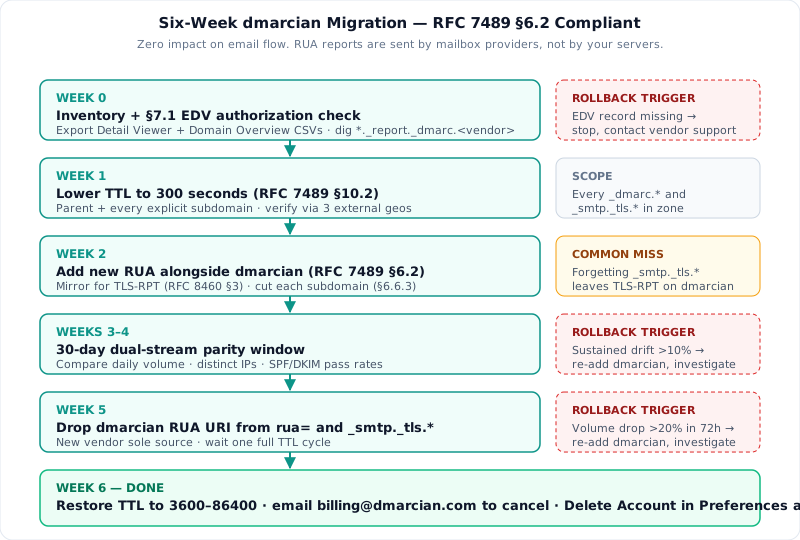
Six-Week RUA Cutover Playbook (RFC 7489 §6.2 Compliant)
Six-week dmarcian to new-vendor cutover
-
Week 0 — Inventory and authorization check. Inventory all
_dmarc.*and_smtp._tls.*records. Export Detail Viewer and Domain Overview CSV/JSON from dmarcian for every domain — this is your historical baseline, unrecoverable after cancellation. Verify the new vendor’s wildcard EDV record returnsv=DMARC1. Rollback trigger: EDV record missing → do not proceed. -
Week 1 — Lower TTL to 300 seconds on every policy record (parent + each explicit subdomain) per RFC 7489 §10.2. Restore to 3600+ after the cutover. Confirm propagation via three external geographic resolvers.
-
Week 2 — Add the new vendor’s RUA URI alongside dmarcian’s in a comma-separated
rua=list. RFC 7489 §6.2 mandates receivers support at least two URIs separated by commas. Mirror the change for every_smtp._tls.*record — TLS-RPT cuts over as a separate DNS operation per RFC 8460 §3, and forgetting it leaves TLS failure telemetry going to dmarcian after DMARC has moved. Cut over each explicit_dmarc.<subdomain>record independently — RFC 7489 §6.6.3 makes receivers query the subdomain record first, sosp=on the parent does NOT govern RUA destinations for subdomains that publish their own record._dmarc.example.com. TXT "v=DMARC1; p=none; rua=mailto:abc@rua.dmarcian.com, mailto:TOKEN@reports.dmarcguard.io; fo=1" -
Weeks 3–4 — 30-day dual-stream parity window. Compare daily volumes, distinct source IPs, and SPF/DKIM pass rates between the two dashboards. Under 5% drift is acceptable; sustained drift over 10% is your rollback trigger. RUF reports are effectively a non-feature for cutover monitoring — Google, Microsoft, and Yahoo do not send RUF. Don’t gate the cutover on RUF parity.
-
Week 5 — Drop the dmarcian RUA URI from
rua=and from_smtp._tls.*. Wait one full TTL cycle. Volume drop over 20% in 72 hours is your rollback trigger. -
Week 6 — Restore TTL to 3600–86400 seconds. Email
billing@dmarcian.comto cancel per dmarcian’s cancellation help article. Trigger Delete Account in Preferences after written confirmation of the data deletion timeline. Archive zone-file snapshots and final CSVs.
The depth of this playbook — RFC-cited, §7.1-aware, TLS-RPT-aware, subdomain-aware — is the white-space the rest of the SERP leaves on the table. If your migration breaks, it is almost certainly one of those four checks.
Frequently Asked Questions
What are the best alternatives to dmarcian?
The verified public switcher destination for SMBs is DMARC Report (DuoCircle), per three Capterra reviews from 2024. PowerDMARC and EasyDMARC are the next most-cited alternatives. DMARCguard covers all 9 email authentication protocols (vs dmarcian’s 3) including ARC and DANE — the broadest coverage in the market. Choose by protocol depth, MSP needs, or budget.
How much does dmarcian cost per month?
dmarcian publishes four tiers at dmarcian.com/pricing: Personal free (2 domains, 1,250 messages, non-business AUP), Basic $19.99/mo annual (2 domains, 100K messages), Plus $199/mo annual (8 domains, 1M messages), Enterprise $499/mo annual (15 domains, 5M messages). Above 15 domains or 5M messages is sales-gated Custom pricing.
Is dmarcian free?
dmarcian offers a free Personal plan with 2 domains, 1,250 DMARC-capable messages per month, and 1-month retention. The plan is non-business use only and dmarcian audits compliance — accounts found tied to a business expire. DMARCguard’s free tier covers 2 domains, 30 days of history, 7 of 9 protocols, with no business-use restriction.
Is dmarcian safe to use?
Yes. dmarcian is a 12-year-old DMARC monitoring platform founded by DMARC spec co-author Tim Draegen and holds public ISO 27001:2022 certification (2025) plus ISO 27017, 27701, and 22301. Note that the dmarcian.eu identity is contested per a February 2024 Hague Appellate court ruling; the historical EU partner now operates as DMARC Advisor BV.
Why did DMARC fail?
DMARC fails when neither SPF nor DKIM aligns with the From-header domain. The seven most common causes are SPF too many lookups, DKIM signature stripping, forwarding chain breakage, missing DKIM signing, misconfigured subdomains, third-party sender misconfiguration, and policy syntax errors. Walk through each with our DMARC failed troubleshooting guide.
Choosing Your Next DMARC Monitoring Tool
Three findings should drive the decision. Protocol coverage: dmarcian stops at DMARC, SPF, and DKIM with TLS-RPT bolted on; DMARCguard ships 9 protocols (7 free, all 9 on Pro). Pricing math: the 10× Basic-to-Plus jump is the dominant switcher trigger; Enterprise gates API, SSO, and Domain Discovery at $5,988/year; mid-term cancellation is non-refundable. Migration: a six-week RFC-§6.2-compliant cutover with §7.1 EDV verification — no competitor switcher page publishes that depth.
The honest recommendation depends on what brought you here. If price was the trigger and protocol depth is not your bar, DMARC Report is winning the public switcher narrative. For white-label MSP architecture, PowerDMARC is the most established. For PSA integration, EasyDMARC. For protocol coverage — ARC, DANE, hosted MTA-STS, BIMI — DMARCguard covers all nine. Stay on dmarcian if you have a stable two-domain footprint inside Basic, value the founder credibility of the DMARC spec co-author, and do not need API, SAML SSO, BIMI, MTA-STS hosting, ARC, or DANE — the reporting depth is genuinely well-regarded.
For the broader 2026 landscape, see our best DMARC monitoring tools roundup. Switching takes 30 minutes of DNS work and six weeks of parallel monitoring, with zero impact on email flow.