What Is DANE? TLSA Records & SMTP DANE [2026]
DANE binds your mail server's TLS certificate to DNS with DNSSEC and TLSA records. Learn how TLSA records work, DANE vs MTA-STS, and SMTP DANE setup.
30 of 5,499,028 scanned domains publish a DANE TLSA record for SMTP — 0.0% adoption
What Is DANE (DNS-Based Authentication of Named Entities)?
DANE (DNS-Based Authentication of Named Entities) is a protocol that publishes TLS certificate information directly in DNS, secured by DNSSEC. For email, DANE lets receiving servers verify your mail server’s certificate without relying on traditional certificate authorities (CAs).
Unlike the standard Web PKI model where hundreds of CAs can issue certificates for any domain, DANE gives you precise control: you pin your exact certificate (or CA) in DNS, and only that certificate will be trusted. This eliminates CA compromise risks and prevents man-in-the-middle attacks that exploit TLS downgrade vulnerabilities.
DANE for email is defined in RFC 7672 (SMTP Security via Opportunistic DNS-Based Authentication of Named Entities Using DANE). The underlying TLSA record format comes from RFC 6698.
Why DANE Matters: Certificate Pinning for Email
The traditional CA model has a fundamental weakness: any trusted CA can issue a
certificate for your domain. If a CA is compromised, misconfigured, or coerced
by an attacker, they could obtain a fraudulent certificate for
mail.yourdomain.com and intercept your email traffic.
DANE solves this with certificate pinning: you publish a cryptographic fingerprint of your mail server’s certificate in DNS. When a sending server connects via TLS, it retrieves your TLSA record through DNSSEC, verifies your certificate matches the published fingerprint, and refuses delivery if verification fails.
This provides two critical protections:
- CA bypass: With DANE-EE (end-entity) mode, you can use a self-signed certificate. No CA is involved, eliminating CA compromise risk entirely.
- Mandatory TLS: If a valid TLSA record exists, TLS becomes mandatory. Attackers cannot downgrade to plaintext SMTP.
DANE also solves the same TLS downgrade problem as MTA-STS, but uses a fundamentally different trust model.
How DANE Works (RFC 7672)
When a mail server wants to send email to your domain, here’s what happens:
- MX lookup: The sender queries your domain’s MX records to find your mail
server hostname (e.g.,
mail.example.com). - TLSA lookup: The sender performs a DNSSEC-validated query for
_25._tcp.mail.example.com.to retrieve your TLSA record. - TLS connection: The sender connects to your mail server on port 25 and initiates STARTTLS.
- Certificate verification: Your server presents its TLS certificate. The sender verifies it matches the TLSA record constraints.
- Delivery decision: If verification succeeds, mail is delivered. If it fails, delivery is refused (no fallback to plaintext).
The MX hostname’s TLSA record is checked, not the envelope domain’s. If your MX
record points to mail.yourdomain.com, you publish the TLSA record at
_25._tcp.mail.yourdomain.com, not _25._tcp.yourdomain.com.
How DANE Stops STARTTLS Stripping
Without DANE, TLS on port 25 is an offer, not a rule. The sending server opens
a cleartext SMTP session, reads the EHLO response, and negotiates TLS only if
it sees a STARTTLS capability. An attacker on the network path who rewrites
that one line pushes the sender back to plaintext, and the sender has no way to
tell. RFC 7672 (Section 1.3.1) states the problem plainly: “The server’s
indication of TLS support can be easily suppressed by an MITM attacker. Thus,
pre-DANE SMTP TLS security can be subverted by simply downgrading a connection
to cleartext. No TLS security feature can prevent this. The attacker can simply
disable TLS.”
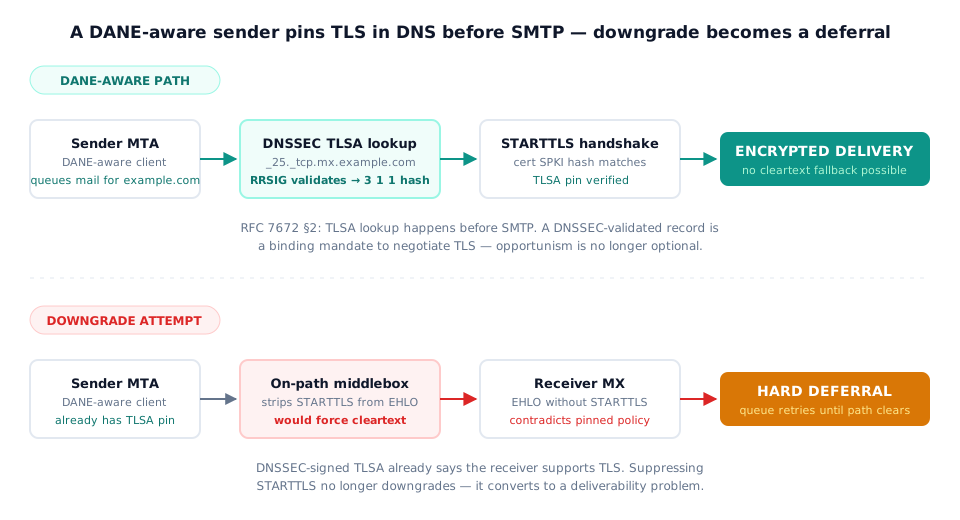
DANE moves the TLS decision out of the SMTP conversation and into DNSSEC. The
sender resolves the TLSA record before it connects, and RFC 7672 (Section 2.2)
lets it treat a DNSSEC-validated TLSA record as a commitment by the receiving
domain that its server supports TLS and STARTTLS. Once the sender holds that
signed record, a missing STARTTLS capability or a certificate that does not
match the published hash is no longer a reason to fall back to plaintext: the
client must not deliver through that host (Section 2.2.3). It tries the next MX
host or keeps the message queued until the path stops tampering. The downgrade
becomes a deferral instead of a leak.
Two limits are worth knowing. DANE for SMTP covers MTA-to-MTA delivery on port 25; RFC 7672 (Section 7) leaves mail-client submission out of scope, so protect ports 465 and 587 with implicit TLS and strict certificate validation instead. And DANE authenticates the server’s certificate — it cannot undo commands a vulnerable server buffered in plaintext before the handshake, the STARTTLS injection class documented in Poddebniak et al., USENIX Security 2021 and tracked as CVE-2011-0411 (Postfix) and CVE-2021-38371 (Exim). Keep your MTA patched; DANE does not substitute for that.
The TLSA Record: Field-by-Field Breakdown
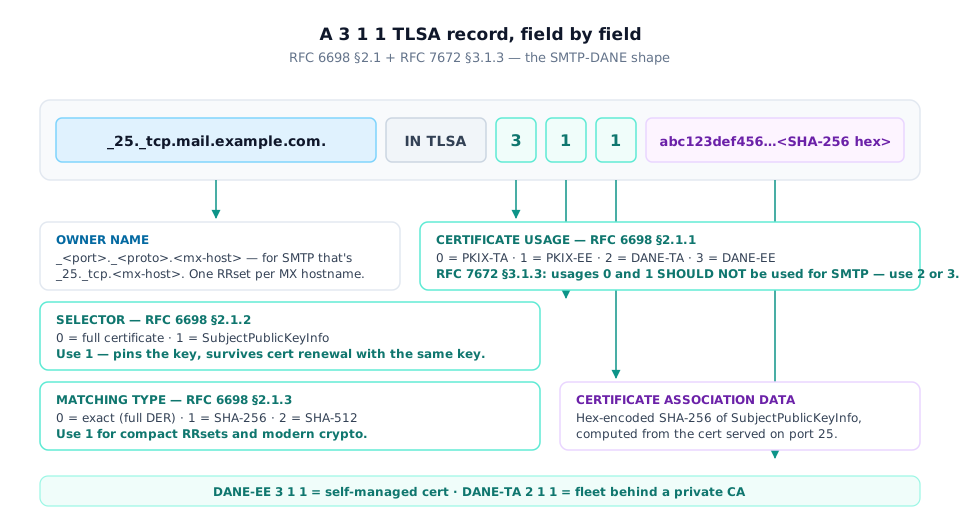
A TLSA record is published at _port._protocol.hostname in DNS. For SMTP on
port 25:
_25._tcp.mail.yourdomain.com. IN TLSA 3 1 1 abc123...The record contains four fields:
| Field | Name | Values | Meaning |
|---|---|---|---|
| 1 | Usage | 0-3 | How to verify the certificate |
| 2 | Selector | 0-1 | What data to match (full cert or public key) |
| 3 | Matching Type | 0-2 | Hash algorithm (or exact match) |
| 4 | Certificate Data | Hex string | The certificate or key fingerprint |
Usage Field (Certificate Usage)
The usage field determines how the certificate is verified:
0(PKIX-TA): Certificate must chain to the specified trust anchor (CA) AND be valid per PKIX rules. Not recommended for email.1(PKIX-EE): Certificate must match the specified end-entity certificate AND be valid per PKIX rules.2(DANE-TA): Certificate must chain to the specified trust anchor (CA). PKIX validation is skipped.3(DANE-EE): Certificate must match the specified end-entity certificate. PKIX validation is skipped. This is the most common configuration for email and allows self-signed certificates.
Usages 0 and 1 are effectively unusable for SMTP on port 25: RFC 7672
(Section 3.1.3) says TLSA records SHOULD NOT use them, and DANE-validating
senders may treat such records as unusable because MTAs share no common list
of trusted CAs.
For email, usage 3 (DANE-EE) is recommended. It pins your exact
certificate or public key, doesn’t require a trusted CA, and gives you complete
control.
Selector Field
The selector determines what certificate data is matched:
0(Full certificate): Match the entire X.509 certificate (DER-encoded).1(SubjectPublicKeyInfo): Match only the public key. Recommended because it survives certificate renewal as long as the key pair stays the same.
Recommendation: Use selector 1 to match the public key. This lets you
renew your certificate (updating expiry, organization name, etc.) without
updating the TLSA record, as long as you keep the same key pair.
Matching Type
The matching type specifies how the certificate data is represented:
0(No hash): Full certificate or key data (DER-encoded). Not recommended due to DNS record size limits.1(SHA-256): SHA-256 hash of the certificate or key. Recommended.2(SHA-512): SHA-512 hash of the certificate or key. Stronger but larger DNS record.
Recommendation: Use matching type 1 (SHA-256). It’s widely supported, fits
comfortably in DNS, and provides sufficient collision resistance.
Certificate Data
The final field is the hex-encoded hash (or full data if matching type is 0)
of the certificate or public key, depending on the selector.
TLSA Record Examples
Here are real-world TLSA configurations:
Example 1: DANE-EE with SHA-256 Public Key (Recommended)
_25._tcp.mail.example.com. 3600 IN TLSA 3 1 1 0c72ac70b745ac19998811b131d662c9ac69dbdbe7cb23e5b514b566 64c5d3d6- Usage
3(DANE-EE): Certificate must match exactly; no CA verification. - Selector
1: Match the public key only. - Matching
1: SHA-256 hash. - Data: SHA-256 hash of the server’s public key.
This is the most common configuration for SMTP. It allows self-signed certificates, pins the public key (so certificate renewals don’t break DANE as long as you keep the same key), and uses SHA-256 for a compact record.
To generate this record from your certificate:
openssl x509 -in /etc/ssl/certs/mail.example.com.crt -noout -pubkey | \
openssl pkey -pubin -outform DER | \
openssl dgst -sha256 -binary | \
xxd -p -u -c 32
Example 2: DANE-TA with CA Public Key
_25._tcp.mail.example.com. 3600 IN TLSA 2 1 1 d4de20d05e66fc53fe1a50882c78db2852f1cdbc2d05f8f0e7e0c0c3 dffdb3c3- Usage
2(DANE-TA): Certificate must chain to the specified CA. - Selector
1: Match the CA’s public key. - Matching
1: SHA-256 hash. - Data: SHA-256 hash of the CA’s public key.
This configuration is useful if you use an internal CA or want to pin a specific trusted CA (like Let’s Encrypt) instead of trusting all CAs. Any certificate issued by that CA will be accepted.
Example 3: Full Certificate Match (Not Recommended)
_25._tcp.mail.example.com. 3600 IN TLSA 3 0 0 308202a4308201...- Usage
3: DANE-EE (exact match). - Selector
0: Full certificate. - Matching
0: No hash (full DER-encoded certificate).
This pins the full certificate. You must update the TLSA record every time you renew your certificate, even if the key doesn’t change. DNS record size can also become an issue. Avoid this unless you have a specific reason.
DANE and DNSSEC: Why Both Are Required
DANE’s security depends entirely on DNSSEC. Without DNSSEC, an attacker can perform a man-in-the-middle attack by:
- Intercepting the TLSA DNS query.
- Returning a forged TLSA record matching their fraudulent certificate.
- Intercepting the TLS connection with their certificate.
The sending server would accept the connection because the (forged) TLSA record matches the (fraudulent) certificate.
DNSSEC prevents this by cryptographically signing DNS records. When a DANE-aware mail server queries your TLSA record, it:
- Validates the DNSSEC chain of trust from the root zone to your domain.
- Verifies the TLSA record’s signature using your DNSSEC public key (published in a DNSKEY record).
- Rejects the record if DNSSEC validation fails.
All conforming DANE implementations ignore unsigned TLSA records. If you publish a TLSA record without DNSSEC, it will be invisible to DANE-aware senders.
Setting up DNSSEC requires support from your DNS hosting provider and domain registrar. Both must support DNSSEC signing and DS record publication. This is the primary barrier to DANE adoption — DNSSEC requires coordination between your registrar and DNS host, and not all providers offer it yet. Check with both before planning a DANE deployment. If DNSSEC is not available, MTA-STS provides TLS enforcement without DNSSEC.
Why Do So Few Domains Use DANE?
The gap between encrypting and pinning is the whole story. In DMARCguard’s February 2026 scan of 5,499,028 domains, 2,581,479 (46.9%) offered STARTTLS on port 25, 15,997 (0.3%) published an MTA-STS policy, and 30 published a TLSA record for SMTP. Nearly half of all domains encrypt in transit; 30 pin the certificate that encryption depends on.
Three things have to line up before a TLSA record changes anything, and each is a separate decision by a separate vendor:
- A DNSSEC-signed zone with its DS record at the registrar. The DNS host signs the zone; the registrar publishes the DS record in the parent zone. If either half is missing, the record is “insecure” and DANE-aware senders ignore it.
- A DNS host that can publish the TLSA record type. Not every provider exposes TLSA in its control panel or API, and a zone that cannot hold the record cannot be pinned.
- Senders that validate DANE. A TLSA record only changes the behavior of senders that look it up — see Provider Support for DANE below.
DNSSEC is the barrier. Everything after it — the OpenSSL command, the DNS record, the test — is the shorter half of the work.
How to Set Up DANE for Email
Here’s a step-by-step guide to implementing DANE for your mail server:
1. Enable DNSSEC on Your Domain
Before you can use DANE, your domain must have DNSSEC enabled. Check with your DNS hosting provider and domain registrar:
- DNS hosting provider: Must support DNSSEC signing (e.g., Cloudflare, Route 53, Google Cloud DNS).
- Domain registrar: Must support publishing DS records in the parent zone.
Most modern DNS providers auto-sign records when you enable DNSSEC. You’ll need to copy the DS record from your DNS provider and add it to your domain registrar’s control panel.
Verify DNSSEC is working:
dig +dnssec yourdomain.comLook for the ad (authenticated data) flag in the response and a RRSIG
record.
2. Generate Your TLSA Record
Get your mail server’s TLS certificate and extract the public key hash, or use our TLSA record generator to create one without the command line. The TLSA record setup guide walks through each command below and how to fix a 3 1 1 mismatch. From a PEM file:
# For DANE-EE 3 1 1 (SHA-256 of public key)
openssl x509 -in /path/to/mail.example.com.crt -noout -pubkey | \
openssl pkey -pubin -outform DER | \
openssl dgst -sha256 -binary | \
xxd -p -u -c 32
This outputs a hex string like:
0C72AC70B745AC19998811B131D662C9AC69DBDBE7CB23E5B514B56664C5D3D63. Publish the TLSA Record in DNS
Add a TLSA record to your DNS zone at _25._tcp.<your-mx-hostname>:
_25._tcp.mail.yourdomain.com. 3600 IN TLSA 3 1 1 0c72ac70b745ac19998811b131d662c9ac69dbdbe7cb23e5b514b56664c5d3d6Replace mail.yourdomain.com with your actual MX hostname. The TTL (3600
seconds / 1 hour) is recommended; shorter TTLs are fine during testing.
4. Configure Your Mail Server
Ensure your mail server:
- Supports STARTTLS on port 25.
- Presents the certificate matching the TLSA record.
- Preferably validates DANE on outbound mail (so you benefit from others’ DANE configurations).
For Postfix, enable DANE with:
smtp_dns_support_level = dnssec
smtp_tls_security_level = dane
5. Test Your DANE Configuration
Use a DANE validation tool to verify:
# Using swaks (Send Mail Swiss Army Knife)
swaks --to test@recipient.com --from sender@yourdomain.com \
  --server mail.yourdomain.com --tls --tls-verify-name

Or use [DMARCguard's DANE checker](/tools/dane-checker/)
Check TLS-RPT reports from receiving domains to identify DANE failures.
DANE vs MTA-STS: When to Use Which
DANE and MTA-STS solve the same problem (TLS downgrade attacks) with different trust models:
| DANE | MTA-STS | |
|---|---|---|
| Trust model | DNSSEC (cryptographic) | WebPKI (HTTPS certificates) |
| Self-signed certs | Supported (DANE-EE) | Not supported |
| Requires DNSSEC | Yes (mandatory) | No |
| Adoption barrier | Higher (DNSSEC setup) | Lower (just HTTPS) |
| Certificate pinning | Yes (precise control) | No (trusts any valid CA cert) |
| Sender support | Postfix, Exim, Exchange Online | Gmail, Outlook, Yahoo, most major MTAs |
| Failure mode | Hard fail (no fallback) | Enforced or testing mode |
| Cryptographic strength | Stronger (no CA dependencies) | Weaker (CA compromise risk) |
When to Use DANE
- You already have DNSSEC enabled or are willing to deploy it.
- You want cryptographic certificate pinning without CA dependencies.
- You prefer self-signed certificates (common for internal or high-security mail servers).
- You send to or receive from organizations that validate DANE (banks, governments, EU entities under NIS2).
When to Use MTA-STS
- Your DNS provider or registrar doesn’t support DNSSEC.
- You want faster deployment (MTA-STS requires only HTTPS, no DNSSEC).
- You use certificates from a public CA (Let’s Encrypt, DigiCert) and don’t need pinning.
- You need broader sender support (Gmail, Yahoo, Outlook all validate MTA-STS).
Can You Use Both?
Yes, and many organizations do. DANE-aware senders will use DANE; those that don’t will fall back to MTA-STS. This provides defense-in-depth:
- DANE for senders that validate it (stronger security).
- MTA-STS for everyone else (broader compatibility).
Both DANE and MTA-STS failures are reported via TLS-RPT, giving you visibility into TLS issues.
For a verdict by scenario, sourced to the February 2026 adoption data, see MTA-STS vs DANE: verdict by scenario.
DANE and the NIS2 Directive
The EU NIS2 Directive (effective October 2024) requires “essential entities” and “important entities” to implement “appropriate technical measures” for email security. While NIS2 doesn’t explicitly mandate DANE, it recommends transport security measures including:
- Mandatory TLS for email (via MTA-STS or DANE).
- Certificate validation (DANE’s primary purpose).
- DNSSEC for DNS integrity (DANE’s prerequisite).
Organizations subject to NIS2 should implement MTA-STS at minimum. DANE provides additional defense-in-depth and may be required depending on your national implementing legislation. If your domain already has DNSSEC, adding DANE is straightforward and strongly recommended.
For the clause-by-clause reading — Article 21(2) and Implementing Regulation point 6.7.2(k) mapped to each protocol — see NIS2 email security: Article 21 → DMARC, MTA-STS, DANE.
Outside the EU, industries like finance and healthcare increasingly require transport security. See how DANE fits into PCI DSS 4.0 email requirements for payment card environments. In the U.S., NIST’s SP 800-177 Rev. 1 (Trustworthy Email) recommends that receiving domains implement DANE, MTA-STS, or both for every server in their MX record set (Security Recommendation 5-3).
Provider Support for DANE
DANE support varies by mail server software and hosting provider:
Mail Server Software
| Software | DANE Support | Notes |
|---|---|---|
| Postfix | Full (since 2.11) | Set smtp_tls_security_level = dane |
| Exim | Full (since 4.91) | Set hosts_try_dane = * |
| Microsoft Exchange Online | Full (outbound 2022, inbound Oct 2024) | Outbound validation since 2022; inbound DANE with DNSSEC GA October 2024 |
| Sendmail | Partial | Requires patches; not recommended |
| Halon | Full | Commercial MTA with DANE support |
Email Hosting Providers
Most major email hosting providers (Gmail, Google Workspace, Microsoft 365) do not publish DANE/TLSA records for their mail servers. They rely on MTA-STS instead. However:
- Google Workspace: Does not validate DANE on inbound mail but will accept DANE-protected connections.
- Microsoft 365 / Exchange Online: Validates DANE on outbound mail since
2022, and
inbound SMTP DANE with DNSSEC reached general availability in October 2024
— publishing TLSA records for your tenant requires moving your MX to the
DNSSEC-enabled
*.mx.microsoftendpoint. - Fastmail: Does not support DNSSEC —
Fastmail’s help documentation
states so — which rules out DANE; its MX hosts
(
in1/in2-smtp.messagingengine.com) publish no TLSA records. - Proton Mail: Publishes TLSA records and validates DANE.
If you self-host or use a provider that supports DANE, you can deploy it. If you use Google Workspace or Microsoft 365, focus on MTA-STS instead.
How to Verify Your DANE/TLSA Configuration
DNS Query Test
Check if your TLSA record is published and DNSSEC-signed:
dig +dnssec _25._tcp.mail.yourdomain.com TLSAYou should see:
- A
TLSArecord with your 3 1 1 data. - A
RRSIGrecord (DNSSEC signature). - The
ad(authenticated data) flag in the response header.
If the ad flag is missing, DNSSEC validation failed. Check your DNSSEC
configuration.
DANE Validator Tools
Use DMARCguard’s DANE checker or a command-line tool:
# Using dane-check (from the dane-tools package)
dane-check mail.yourdomain.com 25
Send a Test Email
Send an email from a DANE-aware server (e.g., your own Postfix instance with DANE enabled) to your domain. Check the Postfix logs for DANE validation results:
postfix/smtp[12345]: Verified TLS connection established to mail.yourdomain.com[192.0.2.1]:25: TLSv1.3 with cipher TLS_AES_256_GCM_SHA384 (256/256 bits) key-exchange X25519 server-signature RSA-PSS (2048 bits) server-digest SHA256; matched DANE TLSA 3 1 1 ...The matched DANE TLSA 3 1 1 confirms DANE verification succeeded.
Monitor TLS-RPT Reports
Configure TLS-RPT to receive reports of DANE failures from
sending domains. If DANE validation is failing, you’ll see tlsa-invalid or
certificate-not-trusted failure types in the reports.
Common DANE Issues and Troubleshooting
TLSA Record Doesn’t Match Certificate
Symptom: Sending servers refuse delivery with “DANE verification failed” errors.
Cause: Your TLSA record was generated from an old certificate, or you renewed your certificate without updating the TLSA record.
Consequence: While the mismatch persists, DANE-validating senders treat that MX host as unreachable — RFC 7672 requires them to fall back to the next MX or defer delivery, never to an unauthenticated TLS connection. Their mail queues and retries until it eventually bounces, so a stale TLSA record is a delivery outage for DANE-validating senders, not a cosmetic warning.
Fix: Regenerate the TLSA record from your current certificate (step 2 above)
and update DNS. Use selector 1 (public key) to avoid this issue when renewing
certificates with the same key pair.
DNSSEC Validation Fails
Symptom: dig +dnssec shows no ad flag or returns SERVFAIL.
Cause: DNSSEC chain of trust is broken (missing DS record, expired signatures, clock skew).
Fix:
- Verify your DNS provider’s DNSSEC signing is active.
- Check the DS record is published at your registrar.
- Validate the DNSSEC chain with
dig +trace +dnssec yourdomain.com. - Ensure your server’s clock is accurate (DNSSEC signatures have validity periods).
Wrong Port in TLSA Record
Symptom: DANE validation fails even though the certificate is correct.
Cause: You published the TLSA record at _443._tcp.mail.yourdomain.com
(HTTPS) instead of _25._tcp.mail.yourdomain.com (SMTP).
Fix: SMTP uses port 25. The TLSA record must be at
_25._tcp.<your-mx-hostname>. Port 443 is only for HTTPS services.
TLSA Record at Wrong Hostname
Symptom: DANE validation fails; no TLSA record found.
Cause: You published the TLSA record at _25._tcp.yourdomain.com but your
MX record points to mail.yourdomain.com.
Fix: The TLSA record must match the MX hostname. If your MX is
mail.yourdomain.com, publish the TLSA at _25._tcp.mail.yourdomain.com.
Mail Server Doesn’t Support STARTTLS
Symptom: DANE validation fails with “TLS not available” errors.
Cause: Your mail server isn’t offering STARTTLS on port 25.
Fix: Configure your mail server to support STARTTLS. For Postfix, ensure
smtpd_tls_cert_file and smtpd_tls_key_file are set.
Fallback to Opportunistic TLS
Symptom: Mail is delivered, but DANE isn’t being validated.
Cause: Sending servers may not support DANE, or your DNSSEC/TLSA record is invalid so they fall back to opportunistic TLS (if MTA-STS is also absent).
Fix: This is expected behavior. DANE is not universally supported. Monitor TLS-RPT reports to see which senders validate DANE. Consider deploying MTA-STS for broader coverage.
Troubleshooting a TLSA 3 1 1 Mismatch
A 3 1 1 record combines three field values defined in RFC 6698: usage 3
(DANE-EE — match the end-entity certificate itself, skipping PKIX/CA
validation), selector 1 (SubjectPublicKeyInfo — match only the public key,
not the full certificate), and matching type 1 (SHA-256). A mismatch means
the SHA-256 hash of the public key presented during STARTTLS differs from the
hash published in DNS. Four causes account for nearly every case:
- Certificate renewed with a new key pair. Selector
1survives renewals only while the key pair stays the same. Renewal tooling that generates a fresh key on every renewal changes the SPKI hash — and the TLSA record — each time, unless you configure key reuse. - Hashed the wrong input. Selector
0matches the full DER-encoded certificate; selector1matches only the SubjectPublicKeyInfo. Hashing the whole certificate but publishing it as3 1 1guarantees a mismatch. - Checked the wrong host or port. The record lives at
_25._tcp.<MX hostname>and must be computed from the certificate your MX host presents on port 25 — not your web server’s certificate on port 443, which is often a different one entirely. - Different certificate per MX host. Each MX hostname needs its own TLSA
record matching the certificate that specific host presents. Verify each
_25._tcp.<mx-hostname>against that host directly.
Two things that are not 3 1 1 failure causes: an expired certificate and
a hostname mismatch. With DANE-EE, senders must ignore the certificate’s
expiry date (RFC 7672, Section 3.1.1) and must not perform CN/SAN hostname
checks (Section 3.2.1) — matching the published hash is the entire test.
Running 2 1 1 (DANE-TA, RFC 7672) instead inverts those
failure modes: the presented certificate must chain to the trust anchor
published in the TLSA record, hostname checks against the MX hostname are
mandatory, and standard validity-period checks apply — so an expired
certificate or a name mismatch, harmless under DANE-EE, breaks DANE-TA
delivery.
Compute the Live Hash and Compare
Hash the public key your server actually presents during STARTTLS:
echo | openssl s_client -starttls smtp -connect mx.example.com:25 \
  -servername mx.example.com 2>/dev/null | \
openssl x509 -noout -pubkey | \
openssl pkey -pubin -outform DER | \
openssl dgst -sha256 -binary | \
xxd -p -u -c 32
Or from a local PEM file:
openssl x509 -in /path/to/mail.example.com.crt -noout -pubkey | \
openssl pkey -pubin -outform DER | \
openssl dgst -sha256 -binary | \
xxd -p -u -c 32
Compare the output to dig +short TLSA _25._tcp.mx.example.com. If they
differ, you’ve found your mismatch. The DANE checker
runs this comparison against every MX host for you. For the full debugging
session — decoding Postfix, Exim, and Microsoft 365 error strings and matching
the evidence to each root cause — see
TLSA mismatch troubleshooting.
Fix It Without Breaking Delivery
Never swap the certificate first. RFC 6698’s key-rollover guidance (reiterated for SMTP in RFC 7672) is to pre-publish the new hash alongside the old one:
; During rollover, publish both records
_25._tcp.mail.example.com. IN TLSA 3 1 1 <current-key-hash>
_25._tcp.mail.example.com. IN TLSA 3 1 1 <new-key-hash>
Wait at least one full DNS TTL, deploy the new certificate, confirm senders validate against the new hash, then remove the stale record. Generate the new record with the TLSA record generator.
Frequently Asked Questions
What is a TLSA record?
A TLSA record is a DNS record type that binds a TLS certificate or public key to
a specific service (like a mail server). For email, it’s published at
_25._tcp.mail.example.com. and contains four fields: usage (how to verify),
selector (what to match), matching type (hash algorithm), and the certificate or
key fingerprint itself.
How do I set up DANE for email?
To set up DANE, first enable DNSSEC on your domain. Then generate a TLSA record
from your mail server’s certificate using OpenSSL, publish it in DNS at
_25._tcp.<your-mx-hostname>, and test with a DANE validation tool. Your mail
server must support TLS and present a valid certificate.
What is the difference between DANE and MTA-STS?
DANE uses DNSSEC to verify certificates, allowing self-signed certificates with DANE-EE mode. MTA-STS uses HTTPS for trust and requires certificates signed by a trusted CA. DANE offers stronger cryptographic guarantees but requires DNSSEC, which is harder to deploy. MTA-STS has lower deployment barriers but relies on the Web PKI trust model.
Does DANE require DNSSEC?
Yes. DANE’s security depends entirely on DNSSEC. Without DNSSEC, an attacker could forge TLSA records via DNS spoofing, making DANE worthless. All conforming implementations ignore TLSA records that aren’t validated by DNSSEC. If DNSSEC is not an option for your domain, use MTA-STS for TLS enforcement instead.
Does my email provider support DANE?
Major providers like Microsoft Exchange Online (since 2024), Postfix, and Exim support DANE. Gmail and Google Workspace do not currently validate DANE on inbound mail but will accept DANE-protected connections. Check your provider’s documentation or test with a DANE-enabled mail server to verify support.
Is DANE required for NIS2 compliance?
The EU NIS2 Directive calls for modern transport-security measures but names no specific protocol, so DANE is not explicitly mandatory. Organizations subject to NIS2 should implement MTA-STS at minimum; some national authorities (such as Germany’s BSI) point to DANE, which provides additional defense-in-depth and may be required by your national implementing legislation.
Why doesn’t my TLSA 3 1 1 record match my certificate?
The most common causes are a certificate renewal that generated a new key pair without a TLSA update, hashing the full certificate (selector 0) instead of the public key (selector 1), or checking the wrong host or port — the record must be computed from the certificate your MX host presents during STARTTLS on port 25, not your web server’s certificate on port 443. Recompute the SHA-256 hash of the live server’s SubjectPublicKeyInfo with OpenSSL and compare it to the published record.
How do I compute a TLSA 3 1 1 hash with OpenSSL?
Extract the public key with openssl x509 -noout -pubkey, convert it to DER
with openssl pkey -pubin -outform DER, and hash it with
openssl dgst -sha256. For a live mail server, pipe the certificate from
openssl s_client -starttls smtp -connect <mx-hostname>:25 into that same
pipeline. The hex output is the certificate-association data field of your
3 1 1 record.
Why do so few domains use DANE?
In DMARCguard’s February 2026 scan of 5,499,028 domains, 30 published a TLSA record for SMTP (0.0%), while 2,581,479 (46.9%) offered STARTTLS on port 25. DANE needs three things that rarely line up: a DNSSEC-signed zone with its DS record published at the registrar, a DNS host that can publish TLSA records, and senders that validate DANE. The gap is DNSSEC deployment, not the TLSA record itself.
Related Protocols
Monitor DANE for your domains
Get automated DANE monitoring, actionable insights, and step-by-step remediation guidance.
Start Free