BIMI DMARC Requirements: Exactly What Your Policy Must Say
Your DMARC record can pass on every message you send, and Gmail will still skip your logo. That is the part of the BIMI DMARC requirements most guides gloss over: BIMI gates on the policy you publish, not on whether individual messages pass. Anything weaker than the bar above means no logo — silently.
BIMI is still an IETF Internet-Draft
(draft-brand-indicators-for-message-identification-14,
2026-05-01), not a published RFC, so each mailbox provider’s documentation is
the operative rulebook. DMARC itself is RFC 9989. This post gives you the exact
requirements table, the per-provider rules, and how to read
bimi=skipped reason="insufficient dmarc" when it shows up in your headers.
What DMARC policy does BIMI require?
BIMI requires DMARC at enforcement — a passing message is necessary but not sufficient. Five conditions, all from the draft itself:
| Requirement | Value | Spec source |
|---|---|---|
| Policy level | p=quarantine or p=reject — never p=none | draft-14 Intro |
| Domains covered | Organizational domain AND the From domain recipients actually see (RFC5322.From) | draft-14 Intro |
| Subdomain coverage | a published sp= must NOT be none | draft-14 §7.1 step 8 |
| pct | pct=100 (or tag absent); quarantine + pct<100 = skip | draft-14 §7.1 step 9 |
| Authentication | message must PASS DMARC — SPF and/or DKIM in alignment | draft-14 §7.1 |
The draft’s language is unambiguous: “To participate in BIMI, Domain Owners MUST have a strong [DMARC] policy (quarantine or reject) on both the Organizational Domain, and the RFC5322.From Domain of the message.”
In record terms, the line between a logo and a silent skip looks like this:
# BIMI-ready — enforcement, full coverage, no sp=none
v=DMARC1; p=reject; rua=mailto:reports@example.com;

# Disqualified — each one skips the logo
v=DMARC1; p=none; rua=mailto:reports@example.com;
v=DMARC1; p=quarantine; pct=100; sp=quarantine; rua=mailto:reports@example.com;
v=DMARC1; p=quarantine; pct=25; rua=mailto:reports@example.com;
v=DMARC1; p=reject; sp=none; rua=mailto:reports@example.com;
Two rows deserve a closer look, because they are where working configurations quietly disqualify themselves.
The sp= trap. Receiver rule §7.1 step 8 says that if your DMARC record
publishes a subdomain policy of sp=none, “BIMI processing MUST NOT be
performed” — even when the parent is at p=reject. Publishing sp=none to
shield subdomains silently forfeits the logo. If you use sp= at all, it must
be quarantine or reject; the mechanics are covered in our
DMARC subdomain policy guide.
The pct nuance. DMARCbis —
RFC 9989, published
2026-05-19 — removed the pct tag from DMARC entirely (Appendix A.6). But the
BIMI draft and Google’s documentation still enforce pct=100 where the tag is
present. A leftover pct=25 from a phased rollout is treated as partial
enforcement and skips the logo. The practical rule: delete the tag, or set it
to 100.
2.5% of 73.3 million domains scanned had reached p=reject — the BIMI-eligibility floor is that small.
Why do receivers gate on the policy rather than the pass? Because a logo is a
trust mark. Displaying it on a domain that anyone can spoof — which is what
p=none means in practice — would be worse than showing no logo at all.
DMARCguard’s BIMI validator checks all five rows in the table above against your
live DNS before it ever looks at your logo file, for the same reason.
Which email providers show BIMI logos in 2026?
Four major providers render BIMI logos; one conspicuously does not. Each row below is sourced from the provider’s own documentation:
| Provider | Shows BIMI | DMARC bar (provider’s words) | Certificate |
|---|---|---|---|
| Gmail (GA 2021-07-12) | Yes | p=quarantine/reject, pct=100 | VMC or CMC required (PEM) |
| Apple Mail (iCloud) | Yes | not stated verbatim by Apple | VMC in practice; CMC unconfirmed |
| Yahoo / AOL | Yes | ”quarantine or reject” | none required; bulk mail only |
| Fastmail | Yes | enforcement per the BIMI standard | none required |
| Microsoft 365 / Outlook | No | n/a — no receiver support, no GA date | n/a |
Google’s own wording (doc updated 2026-06-04) matches the draft exactly: “The policy option (p) must be set to quarantine or reject… The percent option (pct) must be set to 100.” Gmail also layers sender reputation on top, and logos can take up to 48 hours to appear — a technically valid record does not guarantee display.
The other providers add their own conditions. Yahoo and AOL show logos only for bulk mail from senders with “sufficient reputation and engagement,” and require no certificate. Fastmail requires none either, and fetches logos at its MX servers when mail arrives — so BIMI cannot be used as an open-tracking pixel. Apple’s receiver docs never state “quarantine or reject” verbatim; that bar comes from the BIMI standard, and in practice Apple Mail displays logos for iCloud-hosted mailboxes with a VMC.
One distinction worth a paragraph: Apple’s “Branded Mail” is not BIMI. It is configured through Apple Business Connect, uses a bitmap logo approved by Apple, requires DKIM, and needs no VMC. A BIMI DNS record does not drive Branded Mail, and vice versa. And the Microsoft gap is the biggest coverage hole in BIMI today: as of mid-2026 there is no receiver-side support and no announced date. The per-client walkthrough — and the record and logo mechanics — live in our BIMI record setup guide; this post stays on the policy side.
VMC vs CMC: which certificate do you need?
Once your DMARC policy clears the bar, the certificate question decides where your logo appears. The BIMI Group’s official issuer list (bimigroup.org/vmc-issuers/, verified 2026-07-28) names exactly three Mark Verifying Authorities: DigiCert, GlobalSign, and SSL.com. Entrust — an original issuer — stopped issuing VMCs on 2025-05-12; existing Entrust certificates run until natural expiry.
| Certificate | Eligibility | Unlocks (2026) | Issuer-direct price |
|---|---|---|---|
| VMC | registered trademark | Gmail logo + verified checkmark; Apple Mail | DigiCert $1,416.00/yr; SSL.com $1,500 / $1,350 / $1,275 per yr for 1/2/3-yr terms |
| CMC | 12 months provable public logo use (archive-verified) | Gmail + Yahoo logo; no checkmark; no Apple | no issuer list price published — reseller quotes run ~$649–$1,089/yr |
| None | — | Yahoo, AOL, Fastmail | $0 |
GlobalSign does not publish pricing on its own site, and no issuer cleanly lists
a standalone CMC price — treat any CMC figure you see as a reseller quote, not a
list price. Both certificate types require DMARC enforcement first: no
certificate activates BIMI on a p=none domain.
The zero-cost row is legitimate, not a consolation prize. If your audience reads mail in Yahoo, AOL, or Fastmail, a self-asserted record displays your logo with no certificate at all — a reasonable way to prove the pipeline works before spending four figures.
One operational detail that bites a year later: maximum certificate validity is 397 days. Set a renewal reminder, because an expired certificate breaks logo display silently while your DNS stays unchanged. The deeper buying decision — validation steps, trademark offices, lead times — is covered in the setup guide’s certificate section; the table above is the decision in one screen.
Why does Gmail say “bimi=skipped (reason: insufficient dmarc)”?
The good news first: this state is diagnostic, not destructive. Nothing is
wrong with your mail delivery — the message may even show dmarc=pass. The
receiver is telling you one specific thing: your published policy is below
the BIMI bar, so the logo evaluation stopped before it started. Three policy
settings trigger it — p=none, a pct below 100, or sp=none — and every one
of them has the same fix path: bring the organizational domain to p=quarantine
or p=reject at pct=100, with no sp=none published. Once the policy
clears that bar, the same header flips to bimi=pass with no other change.
A provenance aside, because no other guide gives you this: the parenthesized
string people search for is a paraphrase. The verified verbatim header in the
wild is iCloud’s, stamped by bimi.icloud.com:
Authentication-Results: bimi.icloud.com; bimi=skipped reason="insufficient dmarc"No raw Gmail header containing a bimi= token has surfaced in public support
threads or deliverability writeups — Gmail surfaces its authentication verdicts
in the “Show original” summary box and in Postmaster Tools instead. The
diagnosis is identical either way.
Here is the state taxonomy, restricted to verified states:
| Header state | Trigger | Fix |
|---|---|---|
bimi=pass header.d=… header.selector=… | DMARC enforced + record/logo/cert valid | none |
bimi=skipped reason="insufficient dmarc" | p=none, pct<100, or sp=none | enforce: p=quarantine/reject, pct=100 |
| skipped — no VMC/CMC (Gmail) | no PEM certificate in a= | obtain a VMC or CMC |
| skipped — SVG/asset failure | not SVG Tiny P/S, wrong MIME, redirect, broken PEM | validate logo + HTTPS hosting |
| skipped — reputation/anti-abuse | low sender reputation despite valid config | improve sender reputation |
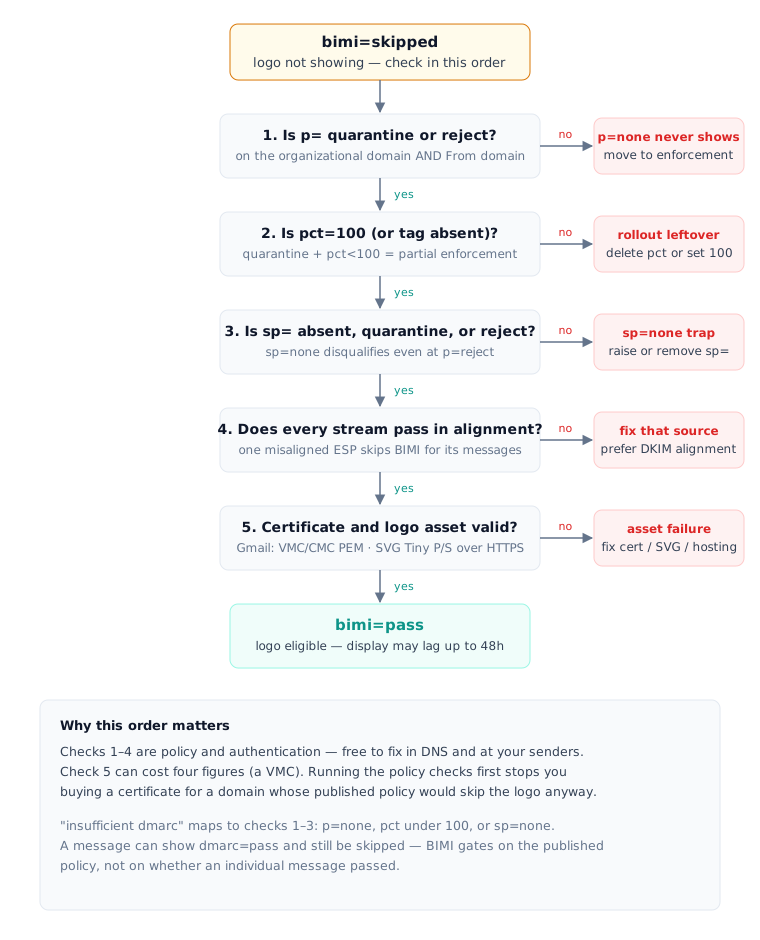
For “insufficient dmarc” specifically, work through the causes in this order — it matches how the failure chain actually breaks:
p=noneon the organizational domain — the most common cause. Community reports of this exact pattern showdmarc=passalongsidebimi=skippedbecause the org domain never left monitoring mode.- Subdomain enforced, org domain at none — the newsletter trap. Yahoo historically checks the sending subdomain and shows the logo; Gmail and the draft require the organizational domain too, so Gmail skips.
- Leftover
pct<100— a phased-rollout artifact likep=reject; pct=25is partial enforcement. Remove the tag or set 100. sp=none— disqualifies the logo even atp=reject(§7.1 step 8).- One sending source failing alignment — the policy is fine, but a specific ESP stream fails SPF/DKIM alignment, so BIMI is skipped for those messages only.
Only after these five come the certificate and SVG checks. That ordering matters: it stops you buying a VMC for a domain whose policy would skip the logo anyway. Run the free BIMI checker to see where your domain sits — it validates all five requirement rows against your live DNS in one pass.
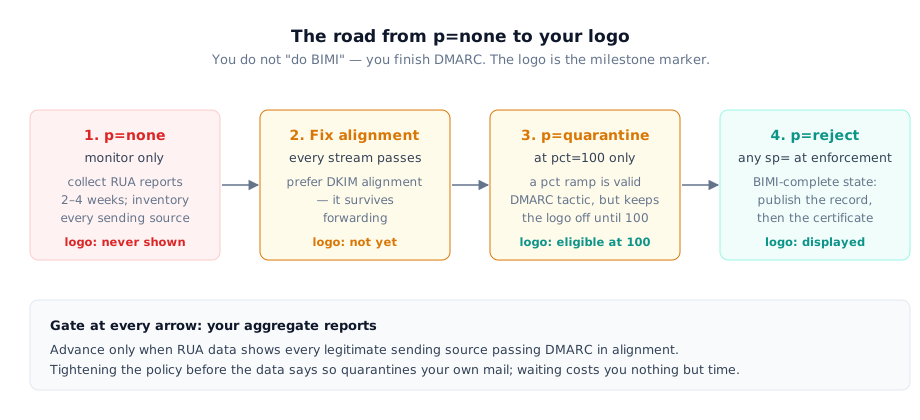
The road from p=none to your logo: enforcement as the BIMI journey
Reframe the project: you do not “do BIMI.” You finish DMARC, and the logo is the milestone marker. Seth Blank, Chair of the AuthIndicators Working Group, put the design intent plainly — BIMI exists so that “DMARC benefits from the providers’ additional incentive to implement the DMARC enforced standard,” and it is “an exciting case where marketers and security professionals are aligned.” The reward was built to pull you through enforcement.
The path, with the decision gate at each stage:
p=none— monitor. Collect RUA data for 2–4 weeks and inventory every sending source. Your DMARC aggregate reports are the evidence base for every advance decision that follows.- Fix alignment. Every legitimate stream must pass DMARC in alignment before you tighten anything. Prefer DKIM alignment — it survives forwarding, so it is the durable path.
p=quarantine— atpct=100. Apctramp is a valid DMARC rollout tactic, but it keeps the logo off until you reach 100. For BIMI, quarantine only counts at full coverage.p=reject, with anysp=at enforcement. This is the BIMI-complete state. Publish the BIMI record per the setup guide, then the certificate if your audience needs one.
57.9% of domains that publish DMARC are still at p=none — most domains are one policy change away from BIMI eligibility, and haven't made it.
The cautionary tale from the other direction: among domains with valid BIMI
records, 4.60% were still at p=none — a published logo, a hosted SVG, and
nothing to show for it (Validity, “The BIMI Battle,” 13,000 domains, 2025). The
record was never the hard part. The policy is.
A word on ROI, honestly. The defensible claim: BIMI puts your verified logo where a spoofer’s mail shows a generic initial — and it certifies, visibly, that your DMARC enforcement is done. The widely quoted engagement numbers deserve more caution. They trace to two sources: a 2021 Red Sift/Entrust consumer survey (1,026 participants, vendor-funded, self-reported — average open-rate lift of 21%, with the famous “+39%” being a single best-brand result) and a 2018 Yahoo Mail pilot that measured a 10% engagement increase. Both are dated, and no independent 2024–2026 study has replicated them.
Frequently asked questions
Does BIMI work with p=quarantine or only p=reject?
Both qualify. The BIMI draft requires a DMARC policy of quarantine or reject on
the organizational domain and the From domain; a quarantine policy must carry
pct=100. A p=none policy never displays a logo, even when every message
passes DMARC.
Does BIMI require DMARC on subdomains?
Yes. The BIMI draft requires enforcement on the organizational domain and the
From domain, and any published sp= tag must not be none. A domain that
enforces only on a sending subdomain may show a logo in Yahoo but will be
skipped by Gmail.
What does “bimi=skipped reason insufficient dmarc” mean?
Your message may pass DMARC, but the published policy is below the BIMI bar:
p=none, a pct value under 100, or sp=none. The verified verbatim header
comes from iCloud. The fix is moving to p=quarantine or p=reject with
pct=100 and no sp=none.
Will pct=50 work for BIMI?
No. The BIMI draft states a quarantine policy must not have a pct below 100,
and Google requires pct=100 explicitly. RFC 9989 removed the pct tag from
DMARC entirely, so the practical guidance is to delete the tag or set it to 100.
Do I need a VMC for BIMI to work in Gmail?
Gmail requires a mark certificate — either a VMC or a CMC — referenced in your BIMI record. A VMC adds the verified checkmark; a CMC shows the logo without it. Yahoo, AOL, and Fastmail display BIMI logos with no certificate at all.
Does Outlook show BIMI logos?
No. Microsoft does not render BIMI in Exchange Online, Outlook, Outlook.com, or Microsoft 365, and has announced no date to. A valid BIMI record and VMC have no display effect in Microsoft-hosted inboxes.
The short version
The BIMI DMARC requirements fit on one line: enforcement — p=quarantine or
p=reject — on the organizational domain and the From domain, pct=100 or no
pct tag, no sp=none, and mail that passes DMARC in alignment. Then the
certificate, then the logo. The requirements table at the top of this post is
the checklist; if every row passes, the logo is an implementation detail. If any
row fails, no certificate or SVG will save it. BIMI is proof that your DMARC job
is finished — which is exactly why it is worth having.
Prefer to start further back? Start monitoring your DMARC reports — free plan, no credit card required.