Yahoo Mail’s MX Change: Which Domains Moved, and What a 450 Asks of You
Yahoo Mail MX records changed for some domains in November 2026, and Yahoo
confirmed it on November 20 in a short post. The post says senders
may see a spike in certain error responses, such as 450 User is receiving mail too quickly. It
does not say which domains changed,
what the new hostnames are, or when the change began.
This post fills in what DNS can answer: the 25 domains, the old host and the new one, and the dates we can support. Then it covers what the 450 reply means, what you should and should not do about it, and the one side effect that does sit on the sender’s side.
What did Yahoo say about its MX records?
Yahoo’s post, published at 21:18 UTC on November 20, makes four statements:
- MX records for some Yahoo Mail domains have changed, as part of updates to Yahoo’s mail infrastructure.
- During the transition, senders may see a spike in certain error responses,
such as
450 User is receiving mail too quickly. - “We are investigating reported issues and making adjustments as needed.”
- Senders who still have delivery issues should use the deliverability support pages on Yahoo’s Sender Hub, and include the full error response, the affected recipient domain and timestamps.
That is the whole post. It gives no list of domains, no old or new hostname, no start or end date, no cause for the replies and no retry advice.
Yahoo has announced an MX change with a list before. In June 2025 the same author announced that the MX records for AT&T domains would point at Yahoo, listed all 13 of them, and said “AT&T domains will gradually be transitioned”.
There is published context for infrastructure work. In August 2025 Google’s cloud blog described a multi-year migration onto Google Cloud of Yahoo Mail, an application with "more than 100 services and middleware components". That post does not mention MX records or inbound mail, and Yahoo’s post does not mention Google.
Which Yahoo domains have a new MX record?
Our lookups show 25 Yahoo country domains publishing one new MX
host, europe.mta.mail.yahoo.com. Three domains that shared their old host
still publish it. Every other Yahoo-hosted family we looked up still publishes a host under yahoodns.net.
The yahoo.de MX record, for one, is now europe.mta.mail.yahoo.com;
yahoo.co.uk’s is still mx-eu.mail.am0.yahoodns.net.
Yahoo has not published this list. It is what DNS answered, one domain at a time. It is not ours alone: Spam Resource, an independent deliverability blog, reported the same split on November 21, and its live tracker lists the same 25 domains on the new host and the same 3 on the old one. Its post adds that it had seen no MX record updates for Yahoo Mail’s US domains.
| MX host | Domains | New host? |
|---|---|---|
europe.mta.mail.yahoo.com | yahoo.at, yahoo.be, yahoo.bg, yahoo.co.za, yahoo.com.hr, yahoo.com.ua, yahoo.cz, yahoo.de, yahoo.dk, yahoo.ee, yahoo.es, yahoo.fi, yahoo.gr, yahoo.hu, yahoo.ie, yahoo.it, yahoo.lt, yahoo.lv, yahoo.nl, yahoo.no, yahoo.pl, yahoo.pt, yahoo.ro, yahoo.se, yahoo.sk | Yes |
mx-eu.mail.am0.yahoodns.net | yahoo.co.uk, yahoo.fr, sky.com | No: the host the 25 left |
mta5.am0.yahoodns.net, mta6.am0.yahoodns.net, mta7.am0.yahoodns.net | yahoo.com and others: yahoo.com, ymail.com, rocketmail.com, myyahoo.com, yahoo.ca, yahoo.com.au, yahoo.co.nz, yahoo.com.br, yahoo.com.mx, yahoo.com.ar, yahoo.com.tr, yahoo.co.il, frontier.com, cox.net | No |
mx-aol.mail.gm0.yahoodns.net | AOL and Verizon: aol.com, aim.com, aol.co.uk, aol.de, aol.fr, verizon.net, netscape.net, compuserve.com | No |
mx-att.mail.am0.yahoodns.net | AT&T: att.net, sbcglobal.net, bellsouth.net, pacbell.net, swbell.net, ameritech.net, currently.com | No |
mx-apac.mail.gm0.yahoodns.net | Yahoo Asia-Pacific: yahoo.co.in, yahoo.in, yahoo.com.sg, yahoo.com.ph, yahoo.com.hk, yahoo.co.id, yahoo.co.th, yahoo.com.vn, yahoo.com.my | No |
mx-tw.mail.gm0.yahoodns.net | Yahoo Taiwan: yahoo.com.tw | No |
mx-rogers.mail.am0.yahoodns.net | Rogers: rogers.com | No |
Two names that look like Yahoo Mail are not part of this. yahoo.co.jp is Yahoo Japan, a separate company with its own MX hosts. yahoo.ch and yahoogroups.com publish a null MX, the record RFC 7505 defines for a domain that accepts no mail.
To see which side of the change a recipient domain is on, run the lookups below or use the MX lookup.
# Which side of the change is a Yahoo-hosted recipient domain on?
dig +short MX yahoo.de        # a domain our lookups found on the new host
dig +short MX yahoo.co.uk     # one still on the old host
dig +short MX yahoo.com       # still mta5, mta6 and mta7.am0.yahoodns.net

# Where the new host points: a CNAME, then an address.
dig +short europe.mta.mail.yahoo.com
Where does europe.mta.mail.yahoo.com point?
The new host is not an address record in Yahoo’s own zone. It is a CNAME, an alias that points one name at another, to a
name under gcp.yahoo.cloud, a zone delegated to Google Cloud DNS, and that
name resolves to addresses registered to Google LLC. The old host
resolves directly to addresses on Yahoo’s network.
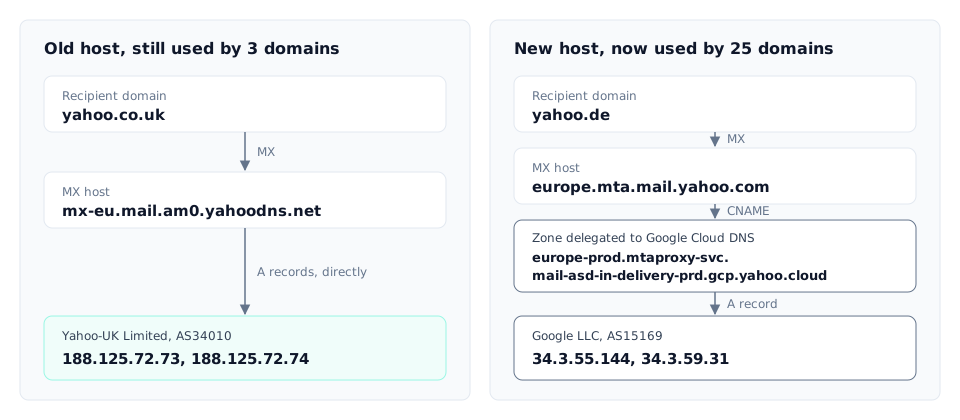
| Old host | New host | Basis | |
|---|---|---|---|
| Name | mx-eu.mail.am0.yahoodns.net | europe.mta.mail.yahoo.com | DNS |
| DNS chain | Address records, directly | CNAME to europe-prod.mtaproxy-svc.mail-asd-in-delivery-prd.gcp.yahoo.cloud | DNS |
| Zone | yahoodns.net, served by Yahoo | gcp.yahoo.cloud, delegated to Google Cloud DNS | DNS |
| Addresses | 188.125.72.73, 188.125.72.74 | 34.3.55.144, 34.3.59.31 | DNS |
| Network | Yahoo-UK Limited (AS34010) | Google LLC (AS15169) | IP registry, ipinfo.io |
| Reverse DNS | mtaproxy1.free.mail.vip.ir2.yahoo.com | None published | DNS |
| SMTP greeting | mtaproxyNNN.free.mail.ir2.yahoo.com | prod-mtaproxy-svc-<hash>-<suffix> | Public test |
| SMTP extensions | PIPELINING, SIZE 41943040, 8BITMIME, STARTTLS | The same four | Public test |
| What it looks like | Named mail hosts on Yahoo’s network | Pods of one service on a container platform | Our reading |
We could not open a mail connection to either host from our own network, so the
greeting and the extensions come from a public SMTP test, not from us. The new
host answered that test with 220 prod-mtaproxy-svc-55ffcfb84c-jb6p4 ESMTP ready, and with a
different suffix on another run. The old one answered
220 mtaproxy204.free.mail.ir2.yahoo.com ESMTP ready.
Our reading: a greeting made of a service name, a hash and a short suffix is how a Kubernetes pod, one running instance of a containerized service, is named, which fits Google’s description of Yahoo Mail on its Kubernetes service. Both hosts offer the same four extensions, which suggests the same mail software at a new address. Yahoo has said neither.
What we can say is that the name resolves to Google Cloud addresses. We cannot say where those machines are or what else runs behind them. One practical consequence: the new addresses publish no reverse DNS, so a reverse DNS lookup on them returns nothing, where the old ones name a Yahoo host.
When did Yahoo change the records?
At least yahoo.de was on the new host before Yahoo’s post. The evidence does not say when the other 24 switched, or whether they switched on one day.
| When | What | Source |
|---|---|---|
| September 2019 | A network operators’ list post shows yahoo.it, yahoo.de and yahoo.co.uk on mx-eu.mail.am0.yahoodns.net; two of the addresses it lists are the two the host still has | SwiNOG list |
| June 24, 2025 | Yahoo announces that 13 AT&T domains will point at Yahoo, and lists them | Yahoo |
| November 15, 2026 | yahoo.de, yahoo.it, yahoo.gr, and yahoo.es still on mx-eu.mail.am0.yahoodns.net | Bulk Email Checker, its own check date |
| November 19, 2026 | yahoo.de on europe.mta.mail.yahoo.com | trashmail-blacklist.org, its own check date |
| November 20, 21:18 UTC | Yahoo publishes its post | Yahoo |
| November 21, 2026 | 25 domains on the new host, 3 on the old one | Our lookups |
The two middle rows come from third-party sites that look up domains and print the date of their own check. They are the only dated checks from before Yahoo’s post that we found, and those pages refresh in place, so a later visit shows a later check. The second site’s page for yahoo.de also lists the other 24 domains as sharing the new host, but each of those rests on its own check, some of them later.
The zones add one more hint. The 25 zones were last edited on four dates, November 4, November 16, November 17, and November 19: 15 of them on November 16 and 8 on November 17. For each of the four domains with a dated snapshot, the zone was last edited after the snapshot that still shows the old host. A zone’s serial dates its last edit, not what the edit was, so we do not read a switch date out of it for any other domain.
We cannot give an exact switch time for any domain.
What does “450 User is receiving mail too quickly” mean?
It is a temporary refusal of one recipient. The sending server keeps the message and tries again later. Nothing in a sender’s DNS has to change for that retry.
SMTP (RFC 5321) settles most of that:
- 450 is “Requested mail action not taken: mailbox unavailable”, with a busy mailbox or a temporary policy block as its examples (§4.2.2).
- Any 4xx reply means “the error condition is temporary, and the action may be requested again” (§4.2.1).
- 450 is one of the replies to
RCPT TO(§4.3.2), the command that names one recipient, and the earlier sightings below that show the stage sayRCPT TO. A reply at that stage refuses that recipient, not the message or the connection.
Yahoo’s reply carries no enhanced status code, the three-part number many servers add after the reply code. The first digit is the part the standard defines, and it says: temporary.
Yahoo’s own SMTP error page lists 421 and 451 as temporary, does not list this reply, and says senders “may retry sending at a later time”. The 450 text comes from Yahoo’s blog post, not from that page.
The reply text is not new. Senders have published it for years, the 2020 and
2025 sightings with a trailing code, tnmpmscs:
- May 2020: a Tor Project issue
- December 2023: a Microsoft Tech Community thread
- the last quarter of 2024: Postmastery's delivery benchmark
- January 2025: a Japanese hosting FAQ
The last of those shows the reply coming from mta7.am0.yahoodns.net, a host yahoo.com still publishes. That page says the reply seems to be returned often when SPF (RFC 7208), DKIM
(RFC 6376) or DMARC (RFC 9989) checks fail. The text of the reply says rate, and
Yahoo’s post puts the possible spike in its transition without giving a cause.
So the reply predates the MX change, and Yahoo says senders may see a spike in certain error responses during the transition, naming this one as an example. We cannot show that the new hosts are the ones sending it. Our own mail drew no such reply, and our delivery records show no mail to the 25 domains from November 1 to November 20, so we have no first-hand sighting to add.
What stops working when the MX hostname changes?
Nothing in your DNS. SPF, DKIM and DMARC records describe who may send as your domain, and your MX record says where your own mail arrives. None of them refers to a recipient’s MX host.
What can stop working is a rule of your own that recognizes Yahoo by hostname.
The old host sits under yahoodns.net. The new one sits under yahoo.com. A
rule keyed on the suffix .yahoodns.net no longer sees the 25
domains as Yahoo.
Spam Resource’s post tells anyone who groups delivery by where MX records point to pay attention. We know of two concrete cases, and one of them was ours.
A sending system’s shipped rule. KumoMTA’s default traffic-shaping file defines Yahoo like this:
# From KumoMTA's assets/policy-extras/shaping.toml
[provider."yahoo"]
match=[{MXSuffix=".yahoodns.net"}]
max_deliveries_per_connection = 20

[[provider."yahoo".automation]]
regex = "\\[TS?S04\\]"
action = "Suspend"
duration = "2 hours"
KumoMTA’s
traffic-shaping guide
says such a rule applies when every MX hostname of the destination matches the
suffix. europe.mta.mail.yahoo.com does not end in
.yahoodns.net.
So under the shipped file, the Yahoo settings do not apply to mail for the 25 domains: a limit of 20 deliveries per connection and a pause on one of Yahoo’s deferral replies. The same guide shows that a rule can list more than one suffix. We state what the rule matches; we do not know that it has anything to do with the 450 replies.
Our own MX lookup. The tool names the provider behind an MX host, and it
matched Yahoo by yahoodns.net alone. It showed “Yahoo Mail” for yahoo.co.uk
and nothing for yahoo.de until we added the second pattern.
So search your own configuration for yahoodns:
- traffic-shaping, throttling or routing rules in the mail server you run
- lists that map MX hosts to mailbox providers, in your own code or reports
- dashboards that group recipients by MX host
- outbound firewall rules that allow port 25 by destination range: the new addresses are registered to Google LLC, not to Yahoo’s network
Two things you can rule out. MTA-STS
(RFC 8461) is not affected: none of
the 25 domains publishes a policy, so the new name breaks none.
yahoo.com does publish one, in testing mode. Its patterns cover only
yahoodns.net hosts, which would matter only if yahoo.com itself moved. Our
MTA-STS policy example walks through that policy.
And a stale DNS cache would clear within the 30-minute TTL the MX records carry today. A TTL is the time a resolver may keep an answer.
Is deferred mail to Yahoo lost?
Not by the deferral. A message answered with a 450 stays in the sender’s queue. It fails to arrive in two cases: the queue gives up before Yahoo accepts it and returns the message as a bounce, or the content expires first, as a one-time passcode does.
How soon a queue gives up depends on what sends your mail. RFC 5321 §4.5.4.1 says “the give-up time generally needs to be at least 4-5 days”. Many sending services stop sooner: among the systems that document a default, the windows run from 8 hours to 5 days.
| Sending system | Retries for | Basis |
|---|---|---|
| Mailgun | 8 hours | default |
| Postmark | 12 hours | most domains |
| Resend | 14 hours | default; 48 hours on Forge |
| Exchange Online | 24 hours | documented behavior |
| Brevo | 36 hours | documented behavior |
| Exchange Server | 2 days | default, configurable |
| Twilio SendGrid | 72 hours | documented behavior |
| Exim | 4 days | default retry rule |
| Postfix | 5 days | default, configurable |
In the Microsoft 365 outage of November 12 we could say which of these windows closed before the provider recovered, because there was a start and an end. Yahoo has given neither, so the table tells you only which windows are short enough to matter if a deferral persists.
What should senders do?
- Do not resend mail that has not bounced. It is still in the queue. A second copy becomes a duplicate when the first is delivered.
- Find what expired. A message that outlived its retry window came back as a bounce or a failure event. Filter those to Yahoo-hosted recipients, the 25 domains first. On Postfix, the commands below list what Yahoo deferred, which host gave the 450, and the queue ID of every message that expired. An expiry line names a queue ID, not a recipient: the last command shows who one of them was for.
- Reissue time-bound mail. Send a new passcode or reset link instead of replaying the stale one.
- Check the suppression list. A 450 is not a bad address. If your system suppressed a Yahoo address only because a message to it expired, remove that entry. Our post on the Apple bounces of November 17 has the full suppression check.
- Leave your DNS alone. Yahoo’s post announces no change to its sender requirements; they are in Google and Yahoo’s bulk-sender requirements.
- Search your configuration for
yahoodns, as the previous section describes. - Report deferrals that continue. Yahoo asks for the full error response, the recipient domain and timestamps. Add the MX host you reached: for these domains it tells Yahoo which side of the change you were on.
- Do not throttle all Yahoo traffic on a hunch. Yahoo names no limit. A slower route for Yahoo is a tool for a deferral your logs show persisting for the same recipients, not for a transition.
# Postfix: mail that a Yahoo host deferred, from current and rotated logs.
# Debian/Ubuntu log to /var/log/mail.log; RHEL-family to /var/log/maillog.

# 1. Recipients a Yahoo host deferred, with the reply and how many times.
#    The pattern covers the old hosts and the new one.
zgrep -hE 'status=deferred .*(yahoodns\.net|mta\.mail\.yahoo\.com)' /var/log/mail.log* \
  | sed -E 's/.*to=<([^>]+)>.*said: ([0-9]{3} [^(]*[^( ]) *\(.*/\1  \2/' \
  | sort | uniq -c | sort -rn

# 2. Only the reply Yahoo's post names, with the host that gave it.
zgrep -hE 'status=deferred .*450 User is receiving mail too quickly' /var/log/mail.log* \
  | sed -E 's/.*relay=([^[]+)\[.*/\1/' \
  | sort | uniq -c | sort -rn

# 3. Queue IDs of messages that outlived the queue lifetime and went back to
#    the sender, whoever they were for. No output means nothing has expired.
zgrep -hE 'status=expired, returned to sender' /var/log/mail.log* \
  | sed -E 's/.*\]: ([0-9A-Za-z]+): .*/\1/' | sort -u

# 4. Who one of those messages was for, and the replies it got. Put a queue ID
#    from step 3 in place of QUEUE_ID.
zgrep -hE 'QUEUE_ID: to=<' /var/log/mail.log*
We ran these commands on made-up log lines in Postfix’s format, not against a live queue.
What changed in Yahoo’s DMARC reports the same week?
The format of the report ID in its DMARC aggregate reports (RFC 9990). Yahoo’s post does not mention reports, and we cannot show the two changes are connected. They happened in the same week.
Every DMARC aggregate report that Yahoo sent to DMARCguard on November 20 and November 21 carries a report ID in a new format. None of the Yahoo reports we hold from before November 20 does.
DMARCguard receives DMARC aggregate reports for the domains it monitors. Each report carries an ID chosen by the sender of the report. These are two IDs Yahoo gave reports about our own sending domain, for November 17 and November 19:
| Report ID | The number before the dot | |
|---|---|---|
| Old format | 1794984571.654675 | A Unix time on the morning after the day the report covers |
| New format | 1795046400.284563893534901698050956643257126643994 | A Unix time: midnight UTC, the start of the day the report covers |
Both runs with the new format also started earlier. Their first reports arrived at 05:14 UTC on November 20 and at 05:13 UTC on November 21; on each of the 15 days before, Yahoo’s first report arrived between 06:23 and 07:20 UTC.
Read this with its limits. It is two days’ runs, the ones covering November 19 and the day after, and the second was still arriving where our data ends. Timing is not cause. And a DMARC report counts mail a receiver accepted and evaluated, so it cannot show a deferral: a deferred message appears in a report only once Yahoo accepts it.
If you parse reports yourself, the change has one consequence. RFC 9990 §3.5.1 requires that a report ID be unique among reports to the same domain, suggests a loose format and calls it “not very strict”. Store the ID as text, never as a number, and do not read a timestamp out of it: in the new format every report for one day starts with the same ten digits. Our guide to what a DMARC aggregate report contains covers the other fields.
How does this compare with November’s other three incidents?
Four mailbox-provider events in November 2026 produced four different SMTP answers and four different jobs for a sender. Yahoo presents this one as announced infrastructure work, and like the Apple event it has no stated end.
| Row | AS9031519 (EX1545193) | EX1550543 | November 17 (Apple) | Yahoo’s MX change | Basis |
|---|---|---|---|---|---|
| Reply | 550 5.7.1 or 550 5.7.23, per Microsoft | 451 4.7.0, 421 4.3.2, 451 4.7.700, SparkPost’s list, which may not be complete | 550 5.1.1, per SparkPost | 450 User is receiving mail too quickly, per Yahoo | Sourced |
| Class | Permanent, policy | Temporary | Permanent, address | Temporary | Our reading |
| What a sender’s system did | Bounced; may suppress | Queued and retried | Bounced; may suppress the recipient | Queued and retried | Our reading |
| What to do | Fix DMARC, resend what bounced | Resend only what expired | Remove the entries that pass the removal test | Wait; resend only what expired | Our reading |
| What persists | The message | The message, if it expired | The recipient, until the entry expires or is removed | The message, if it expired | Our reading |
| Anything to change | Your DMARC alignment | Nothing | Your suppression list | Rules keyed on yahoodns.net | Our reading |
The other three are covered in the AS9031519 bounces, the EX1550543 outage and the Apple bounces. The lesson they share is the first digit: a 4 means wait, a 5 means read the rest.
Frequently asked questions
Did Yahoo change its MX records?
Yes. Yahoo’s postmaster blog said on November 20, 2026 that MX records for some Yahoo Mail domains changed, without naming them. Our DNS lookups found 25 Yahoo country domains, yahoo.de, yahoo.it and yahoo.es among them, publishing europe.mta.mail.yahoo.com. yahoo.com, AOL and AT&T domains still publish MX hosts under yahoodns.net.
Which Yahoo domains changed MX?
Our lookups found 25 domains on the new host: yahoo.at, .be, .bg, .co.za, .com.hr, .com.ua, .cz, .de, .dk, .ee, .es, .fi, .gr, .hu, .ie, .it, .lt, .lv, .nl, .no, .pl, .pt, .ro, .se and .sk. yahoo.co.uk, yahoo.fr and sky.com still publish mx-eu.mail.am0.yahoodns.net. Yahoo has not published a list.
What is europe.mta.mail.yahoo.com?
It is the MX host that 25 Yahoo country domains now publish. The name is a CNAME to a host under gcp.yahoo.cloud, which resolves to addresses registered to Google LLC. The host it replaced, mx-eu.mail.am0.yahoodns.net, resolves to Yahoo’s own network. Yahoo’s post names neither host.
What does 450 User is receiving mail too quickly mean?
It is a temporary refusal of one recipient. RFC 5321 defines 450 as mailbox unavailable, for example busy or temporarily blocked, and every 4xx reply as a condition that may be retried. The sending server keeps the message and tries again. Senders have logged this text from Yahoo since at least 2020.
Should I resend email that Yahoo deferred?
No. A deferred message is still in your sending system’s queue, and a second copy becomes a duplicate when the first is delivered. Resend only mail that expired and came back as a bounce or a failure event, and issue a new passcode or reset link instead of replaying an old one.
Do I need to change my SPF, DKIM, DMARC or MX records?
No. The change is to the MX records of Yahoo’s own recipient domains, and no record in a sender’s DNS refers to a recipient’s MX host. What can need a change is a rule of your own that recognizes Yahoo by the hostname suffix yahoodns.net, such as an MTA traffic-shaping rule.
Is Yahoo Mail moving to Google Cloud?
Google’s cloud blog said in August 2025 that Yahoo is in a multi-year migration of Yahoo Mail onto Google Cloud. That post does not mention MX records. What DNS shows is narrower: the new MX host for 25 Yahoo country domains resolves to addresses registered to Google LLC.
Will yahoo.com and AOL change their MX records too?
Nothing announces it. Yahoo’s post says some domains changed and gives no list and no end date. yahoo.com, AOL, Verizon and AT&T domains still publish MX hosts under yahoodns.net. To check a domain, look up its MX record: a host under mail.yahoo.com is the new kind.
What should you take away from Yahoo’s MX change?
- Yahoo Mail MX records changed for 25 country domains, per our lookups. Yahoo confirms a change and names no domain.
- A
450 User is receiving mail too quicklyreply is a deferral. Read the first digit, leave the message in the queue, and resend only what expired. - Nothing in your DNS changes. Search your own rules for
yahoodns, because the new host is not under that name.
To check where any recipient domain’s mail goes, use the MX lookup. To see each DMARC report as it arrives, start monitoring your DMARC reports: free plan, no credit card.
Updates
- November 21, 2026. First published. It rests on Yahoo’s post of November 20, 21:18 UTC. The report-ID finding rests on two days’ runs.